Kinesthetic Learning High-Order Thinking: How Movement Builds Critical Thinking Skills
A student building a bridge from cardboard may be doing more than practicing engineering. When that student tests the structure, identifies weaknesses, and redesigns it, physical activity becomes an opportunity for sophisticated reasoning.
This connection between kinesthetic learning high-order thinking challenges the assumption that serious intellectual work must happen quietly at a desk.
Movement-based instruction can help students explore abstract concepts, examine evidence, and develop original solutions. However, the educational benefit depends less on how much students move and more on what they must think about while moving.
What Connects Kinesthetic Learning and Higher-Order Thinking?
Kinesthetic learning involves physical movement, hands-on experimentation, and direct interaction with materials to explore academic concepts.
Higher-order thinking skills involve analyzing information, evaluating alternatives, and creating new solutions rather than simply remembering facts.
The connection becomes meaningful when physical experiences require students to make intellectual decisions.
For example, assembling a model of the solar system may demonstrate factual knowledge. Changing the model to explain how orbital relationships work requires deeper conceptual understanding.
According to the revised Bloom’s Taxonomy, outlined in educational resources from Vanderbilt University, analyzing, evaluating, and creating represent increasingly complex cognitive processes.
Teachers can incorporate these processes into hands-on instruction without sacrificing academic rigor.
What Research Reveals About Learning Through Movement
Research suggests that carefully designed physical learning experiences can improve academic performance, although their effectiveness varies across subjects and instructional approaches.
A 2025 meta-analysis available through the National Library of Medicine examined 46 studies published between 2010 and 2025.
Researchers found a moderately positive overall effect of embodied learning on student performance, reporting an effect size of 0.406.
The analysis also identified differences across educational levels and academic disciplines, suggesting that movement-based approaches are not equally effective in every situation.
Importantly, improved academic performance does not automatically establish improvement in higher-order thinking.
That distinction matters because students might remember more information after participating in an activity without necessarily improving their ability to evaluate evidence or solve unfamiliar problems.
The instructional challenge is connecting physical participation with deliberate reasoning.
How Hands-On Experiences Develop Three Advanced Thinking Skills
1. Analysis: Understanding Relationships Through Physical Models
Analyzing requires students to separate complex information into meaningful components and investigate how those components interact.
Physical models make relationships easier to examine because learners can manipulate their arrangement.
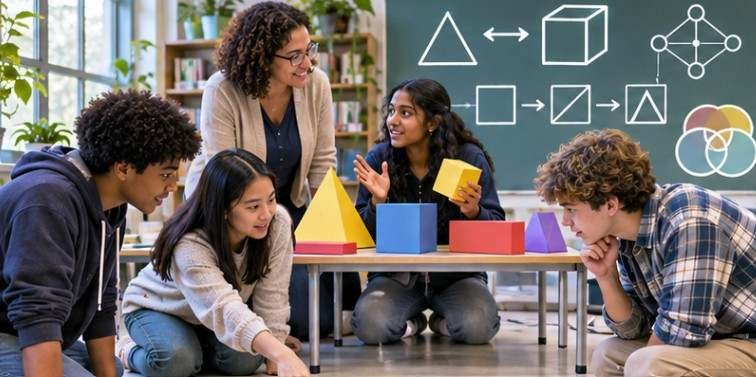
In a middle school mathematics lesson, students might construct geometric shapes using connected rods.
Instead of merely identifying shapes, they investigate how changing angles affects structural stability.
Teachers can deepen the analysis by asking students to identify patterns, compare structures, and explain why particular arrangements behave differently.
2. Evaluation: Testing Claims Against Evidence
Evaluating involves examining evidence, applying criteria, and defending judgments.
Hands-on experiments naturally create opportunities for students to test competing explanations.
Consider an elementary science investigation involving different materials used to prevent soil erosion.
Students construct miniature landscapes, introduce controlled amounts of water, and compare the results.
The important learning occurs when they assess which design performed best, question the reliability of their observations, and identify possible experimental errors.
Physical feedback provides evidence, but students must interpret that evidence.
3. Creation: Developing Solutions Under Real Constraints
Creating demands more than producing an attractive object. Students must combine knowledge, generate alternatives, and justify design decisions.
A high school engineering class might challenge students to construct a protective package using limited materials.
After testing their prototypes, students investigate failures and develop improved designs.
This process connects scientific principles, mathematical reasoning, creativity, and problem-solving.
The finished product matters, but the reasoning behind each revision reveals the depth of learning.
Five Classroom Activities That Make Movement Intellectually Valuable
Turn Classroom Space Into a Mathematical Model
Use floor markings to represent coordinate planes, number lines, or mathematical relationships.
Students physically position themselves to represent solutions, then explain how changing a variable affects the result.
The activity becomes more demanding when classmates must identify errors and defend alternative solutions.
Reconstruct Historical Events Through Evidence
Provide students with historical event cards, primary-source excerpts, and competing interpretations.
Groups arrange events across a classroom timeline while examining relationships between causes and consequences.
Rather than accepting the first arrangement, students must justify their chronology and reconsider conclusions when new evidence appears.
Build and Revise Scientific Systems
Students can construct representations of ecosystems, cellular structures, or energy-transfer systems using manipulatives.
After completing an initial model, introduce a disruption.
For instance, removing one organism from a food web requires students to predict consequences and revise the system.
The objective is explaining relationships, not simply assembling components.
Use Role-Playing to Examine Difficult Decisions
Role-playing allows students to explore competing perspectives in social studies, literature, and civics.
A simulated community planning meeting might assign students roles representing residents, businesses, and environmental organizations.
Participants must evaluate proposals against shared criteria and negotiate competing priorities.
A written reflection afterward helps separate thoughtful analysis from persuasive performance.
Rearrange Arguments With Movable Evidence
Provide students with claim cards, supporting evidence, counterarguments, and explanatory statements.
Students organize the material into logical arguments and revise their arrangements when contradictory information appears.
This technique makes reasoning visible and encourages discussion about the strength of evidence.
How Teachers Can Measure Genuine Higher-Order Thinking
Participation alone is not reliable evidence of critical thinking.
A student might enthusiastically complete a construction challenge while relying entirely on another group member’s decisions.
Assessment should therefore focus on individual reasoning.
Teachers can examine four indicators: the quality of explanations, use of relevant evidence, consideration of alternatives, and ability to revise conclusions.
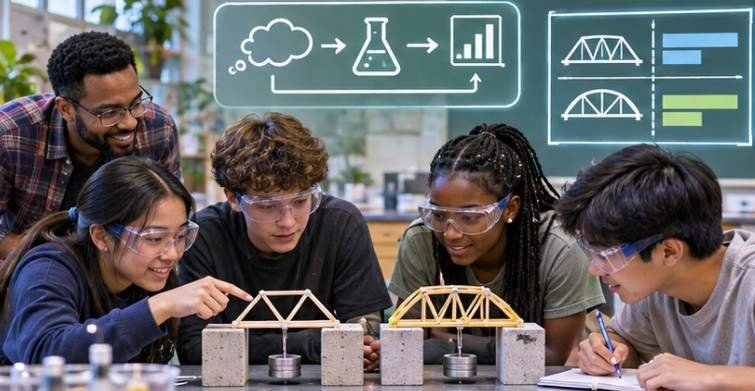
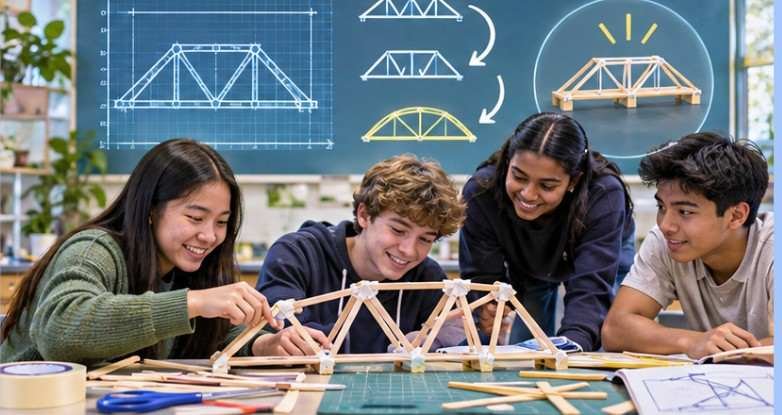
For example, after completing a bridge-building activity, students might independently explain which design feature contributed most to stability.
A stronger response identifies a specific feature, connects it to a scientific principle, and supports the explanation with observations.
A weaker response simply states that the bridge worked.
Short reflection prompts, individual exit tickets, and unfamiliar follow-up problems can reveal these differences without requiring lengthy assessments.
Where Kinesthetic Teaching Can Fall Short
One persistent misconception suggests that students should receive instruction according to fixed visual, auditory, or kinesthetic learning styles.
The American Psychological Association explains that scientific evidence does not support the assumption that matching instruction to a preferred learning style improves learning.
Movement should therefore be selected because it supports the subject matter, not because a student has been labeled a particular type of learner. Accessibility also deserves attention.
Students with mobility limitations, sensory differences, or physical disabilities should have equivalent opportunities to participate.
The CAST Universal Design for Learning Guidelines recommend flexible methods for physical interaction, navigation, and student responses.
Accessible manipulatives, digital simulations, collaborative roles, and alternative response methods can preserve intellectual demands while removing unnecessary barriers.
Finally, movement can become distracting when complicated instructions overwhelm the academic objective. Brief demonstrations and structured reflection help maintain focus.
Frequently Asked Questions
1. How does kinesthetic learning improve higher-order thinking?
Physical activities can support analysis, evaluation, and creativity when students must investigate relationships, defend decisions, and explain solutions rather than merely perform movements.
2. What are examples of higher-order kinesthetic activities?
Engineering prototypes, historical simulations, mathematical floor models, scientific investigations, and evidence-sorting challenges encourage students to solve problems through physical interaction.
3. Is kinesthetic learning suitable for high school students?
Yes. Secondary students can investigate complex scientific systems, test engineering designs, simulate economic decisions, and evaluate historical arguments through structured hands-on activities.
4. Can movement-based learning replace traditional instruction?
Not entirely. Effective teaching combines physical experiences with explanations, reading, discussion, abstract representations, and independent assessment.
Make Every Movement Serve a Thinking Purpose
The strongest classroom activities do not simply keep students occupied. They create opportunities to question assumptions, investigate consequences, and explain discoveries.
I believe the most useful test for any hands-on lesson is surprisingly simple: What intellectual decision must students make that they could not make through repetition alone?
If learners can complete an activity without analyzing evidence or reconsidering their ideas, the task may need redesigning.
Start with one familiar lesson, introduce a meaningful physical challenge, and require students to explain their reasoning.
Movement creates the experience. Thoughtful questioning transforms that experience into learning.