Authentic Intellectual Work Construction of Knowledge Framework: My Classroom Playbook
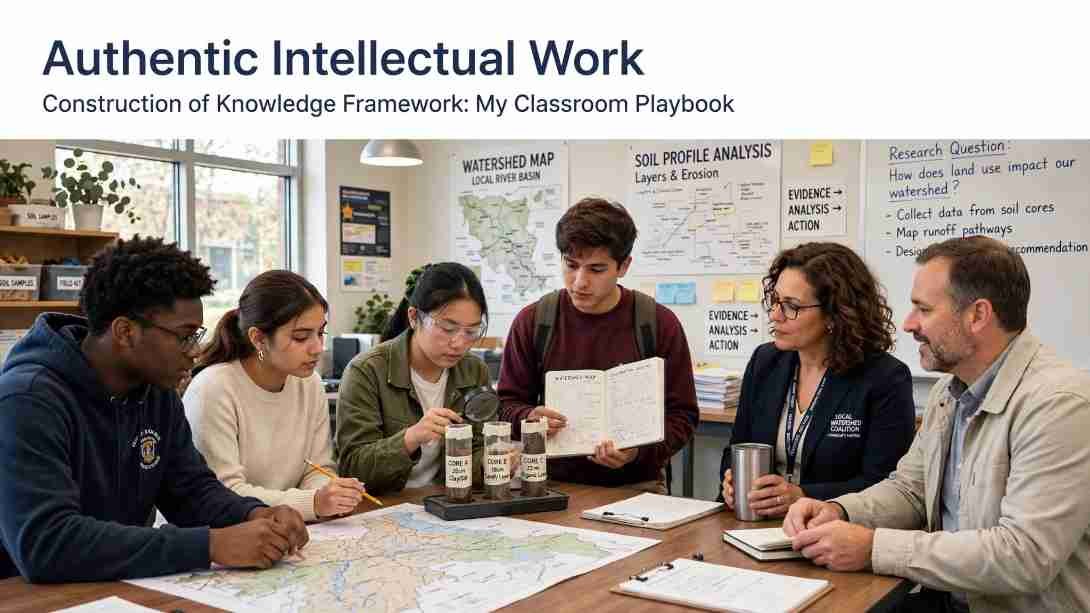
When I watched my high school seniors breeze through a unit test on municipal water systems only to struggle when asked how our local district should allocate its watershed budget, the flaw in my curriculum became clear. Memorizing diagrams is not mastery. To bridge that gap, I integrated the authentic intellectual work construction of knowledge framework into my instructional design, shifting our classroom from passive rote reproduction to genuine, high-stakes cognitive synthesis.
Pioneered by Fred Newmann and his research colleagues at the University of Wisconsin-Madison, this model discards fill-in-the-blank worksheets. Instead, it challenges students to think, analyze, and produce work like working professionals.
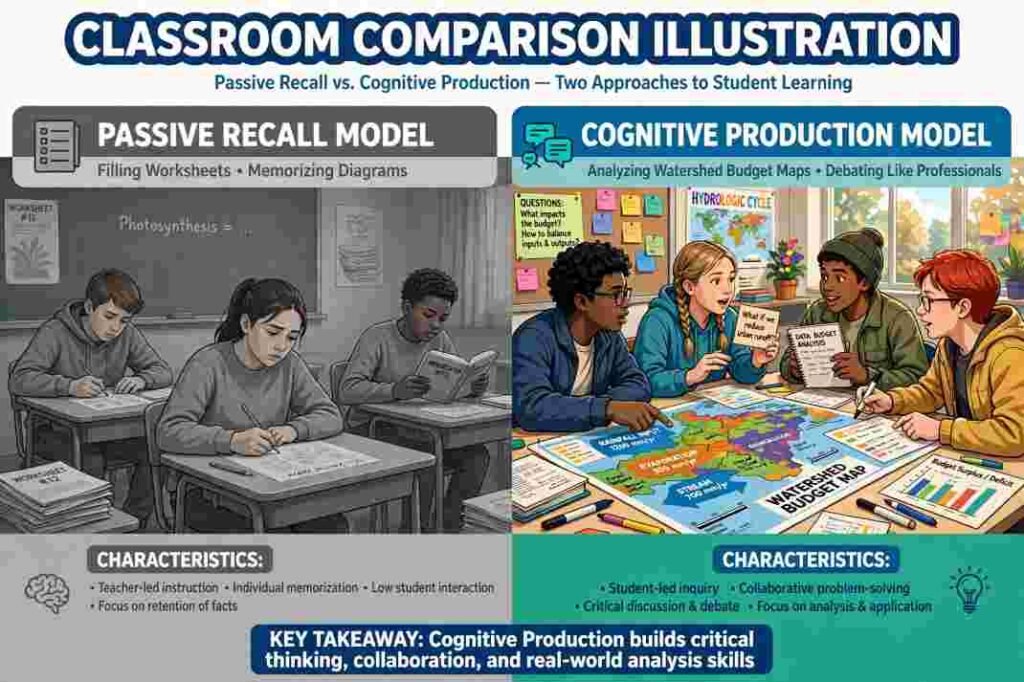
The Shift from Passive Recall to Cognitive Production
Most standard assessment frameworks reward compliance. Students read a passage, identify predetermined definitions, and regurgitate those definitions on cue.
The AIW Institute challenges that model. Newmann argued that genuine intellectual achievement in adulthood requires creating novel meaning rather than echoing pre-recorded conclusions. When students construct knowledge, they examine unstructured scenarios, test conflicting viewpoints, and assemble original arguments.
Deconstructing the Three Pillars of Newmann’s Model
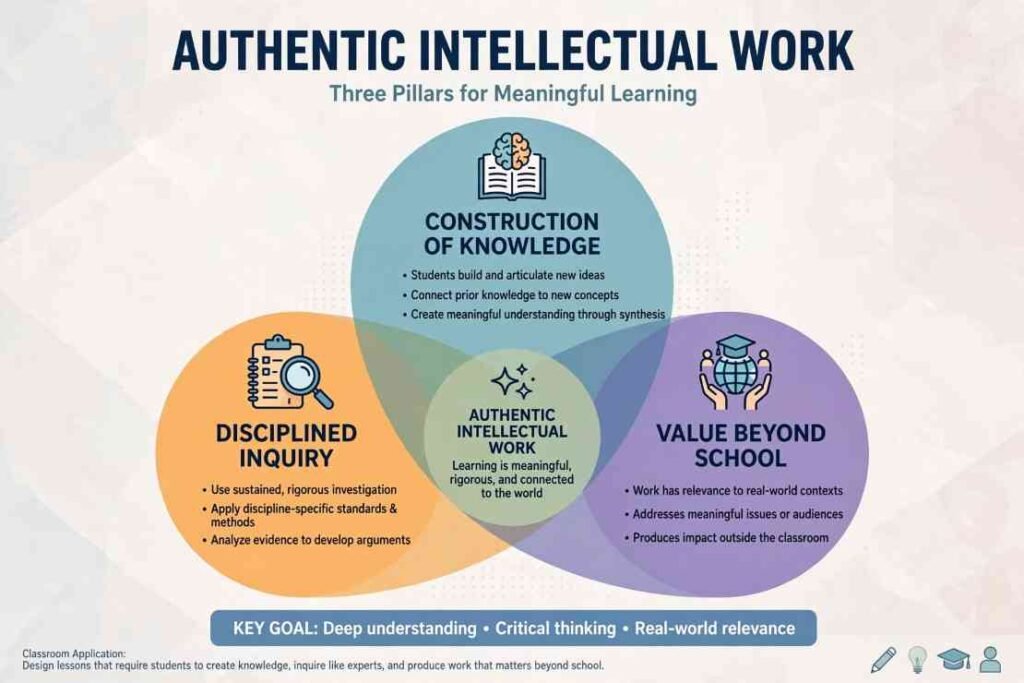
Authentic intellectual work rests on three interrelated criteria that must function simultaneously:
- Construction of Knowledge: The student organizes, interprets, synthesizes, and evaluates raw data to produce an original cognitive product.
- Disciplined Inquiry: The intellectual process adheres to established investigative standards, specialized vocabularies, and systematic methods native to an academic field.
- Value Beyond School: The finished task carries personal, aesthetic, or utilitarian value outside a grade book.
If an assignment hits only one or two criteria, authenticity breaks down. A creative poster might feel authentic, but without disciplined inquiry, it lacks academic substance. A dense research summary showcases disciplined inquiry, but without knowledge construction, it remains a literature report.
How Construction of Knowledge Actually Operates
Building knowledge is not an unstructured free-for-all. In my own teaching, I treat knowledge building as a two-stage process that balances foundational facts with creative problem-solving.
From Foundational Transmission to Original Insight
Students cannot analyze what they do not know. The framework acknowledges a baseline transmission phase where learners internalize core principles, key vocabulary, and foundational mechanics.
The shift happens during the construction phase. Here, students manipulate baseline facts to expose patterns, build hypotheses, and test relationships. For example, in an economics unit, students do not just define supply and demand curves. They use real-time market fluctuations to diagnose supply chain bottlenecks and defend an inventory strategy.
Disciplined Inquiry and Value Beyond School
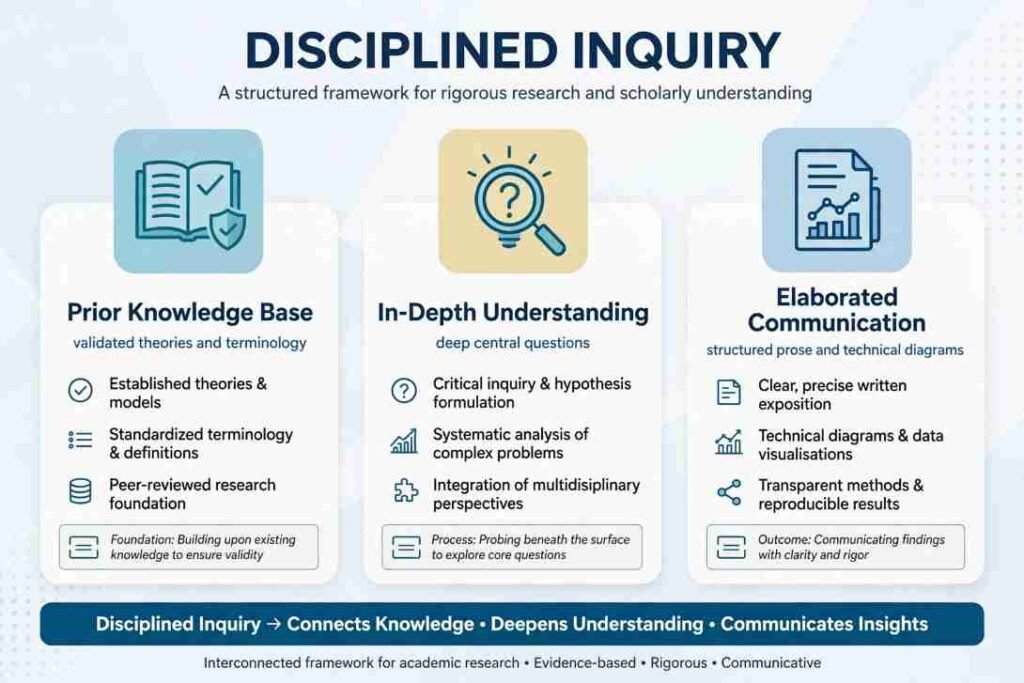
Constructing an argument means nothing if the underlying rationale is flawed. Disciplined inquiry supplies the intellectual guardrails that keep student analysis grounded and credible.
Research published by the American Educational Research Association (AERA) confirms that deep inquiry drives higher achievement across diverse student populations than broad, superficial curriculum coverage.
Grounding Synthesis in Disciplinary Rigor
Disciplined inquiry requires three distinct elements:
- Prior Knowledge Base: Students must ground their claims in validated theories, domain-specific terminology, and core models.
- In-Depth Understanding: Lessons prioritize exploring nuanced, central questions deeply rather than checking off dozens of isolated learning targets.
- Elaborated Communication: Students defend their positions using nuanced, structured prose, technical diagrams, or formal proofs rather than brief sentence fragments.
This inquiry feeds into value beyond the classroom. When students prepare work for authentic stakeholders—such as presenting municipal energy proposals to a city council committee—their motivation and engagement skyrocket.
Field Test: A Real-World Lesson Redesign
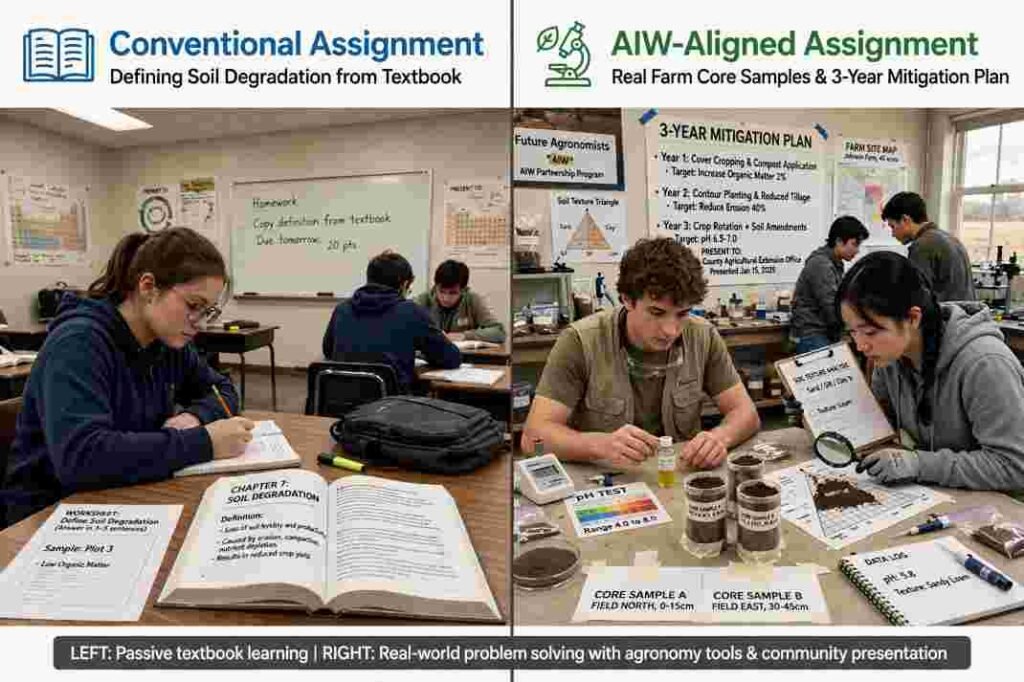
To test how this model transforms student output, I redesigned an environmental science assignment. Below is the side-by-side comparison from my classroom trials.
| Instructional Dimension | Conventional Assignment | AIW-Aligned Assignment |
| Prompt | Define soil degradation and list four preventive methods. | Analyze local farm core samples and recommend a 3-year soil mitigation plan for county farmers. |
| Cognitive Demand | Recall and classification. | Data synthesis, pattern evaluation, and contextual decision-making. |
| Disciplinary Toolset | General textbook glossary. | USDA soil texture triangles, pH assays, and erosion runoff equations. |
| Audience | The classroom teacher (graded on completeness). | County Agricultural Extension Office. |
| Average AIW Rubric Score | 1.8 / 5.0 | 4.6 / 5.0 |
When I swapped the textbook worksheet for agricultural core samples, my students stopped asking, “Will this be on the test?” They began debating whether winter cover crops or contour terracing offered a better return on investment for local growers. They were thinking like agronomists.
Evaluating AIW Across Instruction, Tasks, and Artifacts
Educational initiatives tracked by the National Center for Education Statistics (NCES) show that instructional clarity correlates directly with student achievement. The AIW Institute operationalizes this through rubrics spanning three distinct evaluation domains:
1. Classroom Instruction
Instructional evaluation examines how the teacher leads the classroom. Are classroom conversations genuine exchanges where students build upon peer remarks, or are they teacher-controlled recitations? High-scoring instruction challenges students to question assumptions and defend their logic in real time.
2. Task and Assignment Design
A teacher cannot draw out authentic intellectual work with an uninspired prompt. The assignment itself must require higher-order analysis, structured written elaboration, and authentic problem scenarios.
3. Student Work Artifacts
Evaluating student work focuses strictly on the evidence in the final artifact. Reviewers assess whether the submission demonstrates thorough conceptual grasp, disciplined analytical reasoning, and clear, coherent communication.
Innovative teaching strategies curated by Edutopia underscore that peer-reviewing artifacts against authentic criteria helps teaching teams refine their assignments each term.
Stop Grading Compliance: Actionable Next Steps for Educators
Ditching shallow multiple-choice assessments takes practice, but you do not need to overhaul your entire curriculum overnight.
Pick one upcoming unit and audit your summative assessment against Newmann’s three criteria. If your current task only asks students to reorganize textbook excerpts, replace it with an authentic scenario. Have them evaluate contrasting primary sources, reconcile conflicting datasets, or present their findings to a real community partner. When you demand genuine cognitive production, your students will rise to meet the challenge.
Frequently Asked Questions
1. What is authentic intellectual work construction of knowledge framework?
It is an educational model where students use disciplined inquiry to construct original insights that have practical value beyond school.
2. Who developed the Authentic Intellectual Work framework?
Dr. Fred Newmann and his research colleagues developed the framework at the University of Wisconsin-Madison.
3. How does disciplined inquiry support knowledge construction?
Disciplined inquiry ensures students ground their original ideas in established academic concepts, deep analysis, and elaborated communication.
4. Why is value beyond school necessary for student engagement?
Tasks connected to real-world contexts motivate learners by turning academic work into meaningful civic, personal, or professional problem-solving.