Adapted Physical Education Authentic Assessment For Measuring Skills That Matter
A student may struggle to complete a traditional fitness test yet successfully navigate an obstacle course, participate in a team game, or independently use adapted equipment. Which performance tells us more about their abilities?
That question explains why adapted physical education authentic assessment matters. Instead of relying exclusively on standardized scores, educators observe how students apply movement skills during meaningful activities.
For students with disabilities, this approach provides a clearer picture of independence, physical development, decision-making, and participation. It also helps teachers identify appropriate accommodations, develop measurable Individualized Education Program (IEP) goals, and recognize progress that conventional testing might overlook.
Why Meaningful Assessment Matters for Students With Disabilities
According to the National Center for Education Statistics, approximately 7.5 million students ages 3–21 received services under the Individuals with Disabilities Education Act during the 2022–23 school year.
That represented approximately 15% of public school enrollment.
These figures demonstrate the importance of educational practices that accommodate diverse learning and movement needs.
Measuring Participation Rather Than Physical Performance Alone
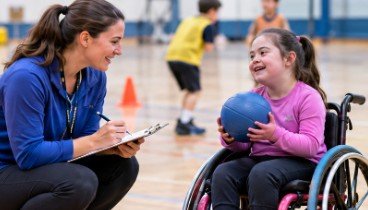
A student with limited mobility might independently maneuver a wheelchair through a recreational activity. Another student might demonstrate improved coordination while using a larger, lighter ball.
Neither achievement is fully captured by conventional athletic performance standards.
Authentic assessment allows educators to examine:
- Functional movement and coordination
- Independent participation in physical activities
- Communication and appropriate peer interaction
- Application of movement strategies
- Appropriate use of adaptive equipment
- Progress toward individualized learning objectives
The objective is not to lower expectations. It is to measure relevant learning outcomes using accessible methods.
Connecting Assessment With Educational Rights
The Individuals with Disabilities Education Act establishes requirements for physical education services for eligible students with disabilities.
Under 34 CFR § 300.108, schools must provide specially designed physical education when required by a student’s IEP.
Authentic assessment can support this process by documenting individual strengths, instructional needs, and measurable progress.
However, classroom observations alone should not replace comprehensive evaluations when additional assessment is necessary.
Four Practical Ways to Assess Students in Real Activities
Effective adapted physical education authentic assessment uses several evidence-gathering methods rather than depending on one performance score.
1. Observe Movement During Familiar Activities
Structured observations allow teachers to evaluate students while they participate in regular physical education lessons.
Consider a student practicing balance during a modified obstacle course.
Instead of measuring only how long the student stands on one foot, the teacher observes whether the student can move between stations safely, negotiate obstacles, and maintain control.
Observations should document the task, environmental conditions, assistance provided, and level of independence.
2. Use Performance-Based Rubrics
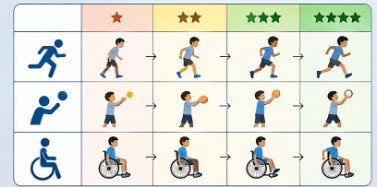
Rubrics transform observations into consistent, measurable evidence.
For example, a four-level rubric for catching an adapted ball might use these criteria:
- Level 1: Requires substantial physical assistance.
- Level 2: Completes the task with physical guidance.
- Level 3: Completes the task with verbal or visual prompts.
- Level 4: Completes the task independently under established conditions.
These levels are illustrative, not a universal scoring standard.
Teachers should define expectations before assessing and ensure the scoring criteria reflect the student’s individual learning goals.
3. Collect Movement Portfolios
A movement portfolio documents student development across multiple lessons.
Teachers might include brief observation records, skill checklists, student reflections, and appropriately authorized videos.
For example, documenting a student’s progress in striking a stationary ball over eight weeks can reveal improvements in coordination, positioning, and independence.
Students can also participate through accessible self-assessments using pictures, communication devices, or simple rating scales.
4. Assess Decision-Making During Games
Physical education involves more than executing movements.
Students must interpret instructions, respond to changing environments, and choose appropriate actions.
During a modified basketball activity, teachers might assess whether a student identifies an available teammate, selects a suitable pass, or adjusts positioning.
These activities can also support higher-order thinking through kinesthetic learning, connecting physical experiences with problem-solving.
Combining Authentic Observations With Formal Assessment Tools
Authentic assessment provides valuable contextual information, but standardized instruments can offer complementary evidence.
The Test of Gross Motor Development, Third Edition (TGMD-3), assesses fundamental movement skills under standardized conditions.
The Brockport Physical Fitness Test offers fitness assessment options developed for young people with disabilities, while the Adapted Physical Education Assessment Scale II (APEAS II) supports motor assessment and progress monitoring.
According to SHAPE America, APEAS II measures areas including locomotor skills, object control, perceptual-motor functioning, and physical fitness.
Teachers should select instruments based on their intended purpose, appropriate age range, accessibility, and technical guidance.
A standardized assessment might establish a baseline, while classroom observations reveal whether those abilities transfer into meaningful activities. Using both approaches can provide a more complete understanding of student performance.
A Five-Step Framework for Classroom Assessment
Schools can begin with a straightforward process that connects daily instruction with measurable outcomes.
Step 1: Identify an Individual Learning Priority
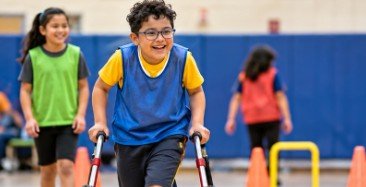
Review the student’s current performance, IEP goals, and relevant physical education curriculum standards.
Choose a functional skill that contributes directly to participation.
For example, a student might work toward independently transferring an object to a partner during cooperative games.
Step 2: Design an Accessible Activity
Select an activity that allows the student to demonstrate the targeted skill.
Modify equipment, instructions, space, or timing when appropriate.
Document these adaptations so future observations remain comparable.
Step 3: Establish Observable Success Criteria
Define exactly what successful performance looks like.
An illustrative target might be completing four successful passes during five opportunities with no more than one verbal prompt.
This is a sample instructional criterion, not a prescribed IEP standard.
Step 4: Gather Evidence Across Multiple Sessions
Collect information during several lessons rather than relying on one observation.
Record the number of opportunities, successful attempts, assistance level, and relevant environmental conditions.
For example, seven independent completions across ten opportunities produces a 70% success rate.
Step 5: Adjust Instruction Using the Results
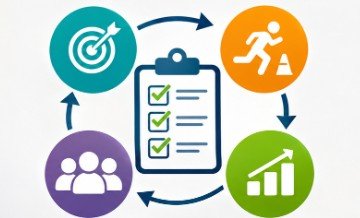
Review whether progress reflects improved skill, reduced assistance, or increased participation.
If performance remains inconsistent, investigate possible barriers involving equipment, instructions, fatigue, sensory conditions, or task difficulty.
Then modify instruction and reassess under comparable conditions.
Common Assessment Mistakes That Distort Student Progress
Authentic assessment is valuable only when observations are accurate and scoring practices remain consistent.
One common mistake is confusing participation with mastery. Attending an activity does not necessarily demonstrate that a targeted motor skill has developed.
Another problem is comparing students against classmates rather than evaluating individual progress toward appropriate goals.
Teachers should also avoid changing equipment or assistance levels without documenting those changes. Otherwise, apparent improvement may reflect different testing conditions rather than skill development.
The CDC’s inclusive physical education guidance emphasizes adapting teaching methods, equipment, environments, and assessments to support students with disabilities.
Importantly, authentic assessment does not mean every task must occur in a competitive game. Quiet environments, individual routines, and carefully structured activities may provide more valid evidence for some students.
Frequently Asked Questions
What is the main purpose of authentic assessment in adapted PE?
It measures how students apply physical, motor, and participation skills during meaningful activities, providing evidence of individual progress and instructional needs.
How often should teachers conduct authentic assessments?
Teachers should collect observations regularly during instruction, with formal progress reviews scheduled according to IEP requirements and district policies.
Can authentic assessment replace standardized motor testing?
Not always. Standardized assessments may provide important diagnostic or comparative information, while authentic observations reveal functional performance in everyday activities.
How can teachers make assessments fair?
Use individualized criteria, consistent rubrics, appropriate accommodations, repeated observations, and clearly documented assistance levels.
Measure Progress Where It Happens
The most meaningful evidence of physical development may emerge during an ordinary lesson rather than a formal testing session.
A student who independently joins a modified game, successfully operates adaptive equipment, or responds to movement challenges demonstrates abilities worth documenting.
For educators, the priority is creating assessment systems that recognize these achievements without sacrificing accuracy or accountability.
Start by selecting one meaningful skill, establishing observable criteria, and tracking performance across several lessons.
The result is more than a collection of scores. It is a clearer understanding of how each student learns, participates, and develops greater independence.