Authentic Intellectual Work Standards for Knowledge Construction Analysis
Most classroom assessments settle for information retrieval disguised as critical thinking. When evaluating curricula across secondary classrooms, I repeatedly encounter assignments where students copy definitions, rearrange pre-digested formulas, and receive perfect marks. Authentic intellectual work standards for knowledge construction analysis cut straight through this illusion of rigor by demanding that learners manipulate, synthesize, and transform information to solve unique challenges.
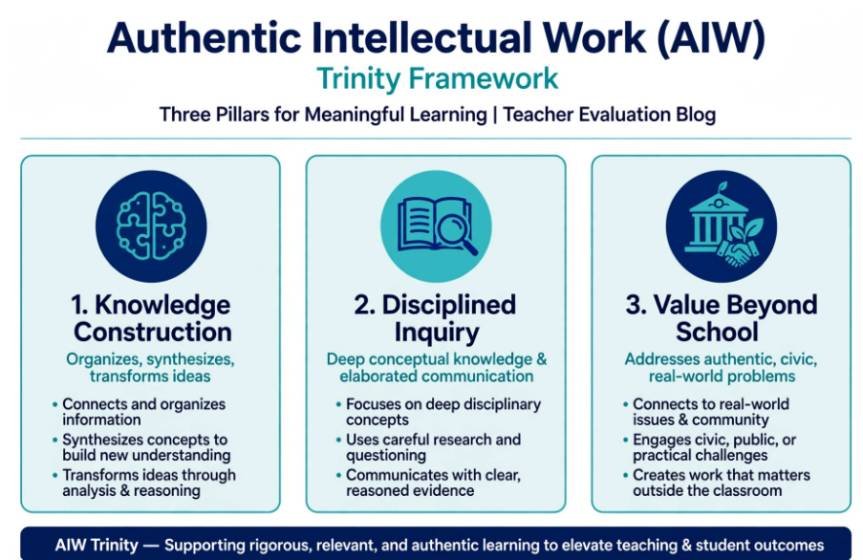
Authentic Intellectual Work (AIW Trinity)
| Component | Description |
| 1. Knowledge Construction | Organizes, synthesizes, and transforms ideas. |
| 2. Disciplined Inquiry | Deep conceptual knowledge & elaborated communication. |
| 3. Value Beyond School | Addresses authentic, civic, or real-world problems. |
The Authentic Intellectual Work framework, developed by Fred Newmann, Bruce King, and Dana Carmichael, redefines educational success around three criteria: Construction of Knowledge, Disciplined Inquiry, and Value Beyond School. When analyzing cognitive tasks, knowledge construction serves as the catalyst. Without it, schoolwork remains an exercise in short-term recall that evaporates the moment testing windows close.
The Core Anatomy of Knowledge Construction in AIW
In this framework, knowledge construction occurs when learners manipulate information to create new meaning, rather than merely repeating facts.
This distinction is central to the Authentic Intellectual Work construction of knowledge framework, which explains how students develop deeper understanding by synthesizing information, applying disciplined inquiry, and creating meaningful interpretations.
This shift marks the boundary between mechanical compliance and authentic intellect.
Higher-Order Thinking vs. Reproduction Mechanics
Low-demand tasks rely on lower-order thinking: memorizing definitions, copying slide decks, or executing algorithmic procedures with predetermined answers. Higher-order thinking requires students to organize, synthesize, interpret, hypothesize, and critique information.
During coaching sessions, I ask educators: Can a student complete this assignment by pasting segments of the text without understanding the relationships between the concepts? If the answer is yes, the task is strictly reproductive.
Authentic intellectual accomplishment demands that students discover patterns, test alternative viewpoints, and build original arguments. Equipping students with explicit thinking strategies for construction of knowledge helps them cross this threshold, moving from factual storage to cognitive manipulation.
Why Knowledge Construction Demands Disciplined Inquiry
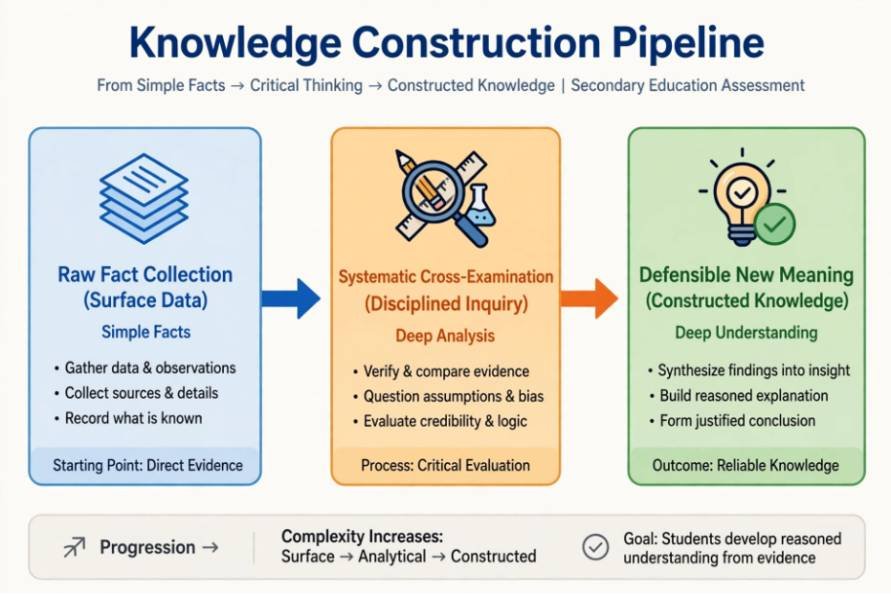
Inventing a novel idea does not make it accurate. Grounding knowledge construction within Disciplined Inquiry prevents creative open-ended tasks from turning into superficial personal opinions.
Raw Fact Collection ──► Systematic Cross-Examination ──► Defensible New Meaning
(Surface Data) (Disciplined Inquiry) (Constructed Knowledge)
Disciplined inquiry anchors student reasoning in established academic vocabulary, historical evidence, scientific methodology, and mathematical proofs. It ensures that constructed conclusions are valid, coherent, and defensible. The National Council for the Social Studies highlights this balance: students achieve lasting gains when they use disciplinary methods to analyze primary sources, rather than skimming summaries from textbooks.
Evaluating the Three AIW Artifacts for Cognitive Demand
The AIW system assesses learning by examining three distinct artifacts: teacher tasks, classroom instruction, and student work. Each requires an intentional scoring focus.
Scoring Teacher Tasks (The Assignment Demand)
Evaluating an assignment focuses entirely on task demand. The analysis scores whether the prompt requires students to manipulate ideas or allows them to succeed via rote recall.
- Level 1 (No Higher-Order Thinking): The prompt relies entirely on memory, multiple-choice questions, or mechanical procedures.
- Level 2 (Moderate Demand): The task is primarily reproductive, with an isolated interpretive component, such as writing a personal reflection after answering factual questions.
- Level 3 (Consistent Construction): The assignment centers on an unresolved problem, requiring synthesis, comparative analysis, or original arguments.
When building departmental systems, using validated rubrics for evaluating student construction of knowledge helps teams score prompt demands objectively during professional learning community audits.
Assessing Classroom Instruction and Substantive Dialogue
Live instruction cannot be evaluated on assignment text alone. Evaluators measure how class time is actually spent. If a teacher delivers an engaging lecture for 45 minutes, students spend that time passively absorbing information rather than actively constructing meaning.
High-scoring AIW instruction fosters substantive conversation. Students converse, challenge claims, explore nuances, and collectively unpack complex problems. The teacher facilitates and prompts rather than controlling every verbal interchange.
Measuring Student Performance and Demonstrated Thinking
Evaluating student performance requires examining the final output. An assignment may request high-level analysis, but the student’s submission may still fall back on superficial summaries.
Scoring student work evaluates how effectively the learner synthesized evidence, organized relationships, and justified their conclusions with elaborated communication. Published studies in the ERIC Database indicate that scoring student work alongside teacher assignments uncovers critical gaps between what educators assign and what students produce.
Field Audit: Calibrating Rubrics for High-Rigor Scoring
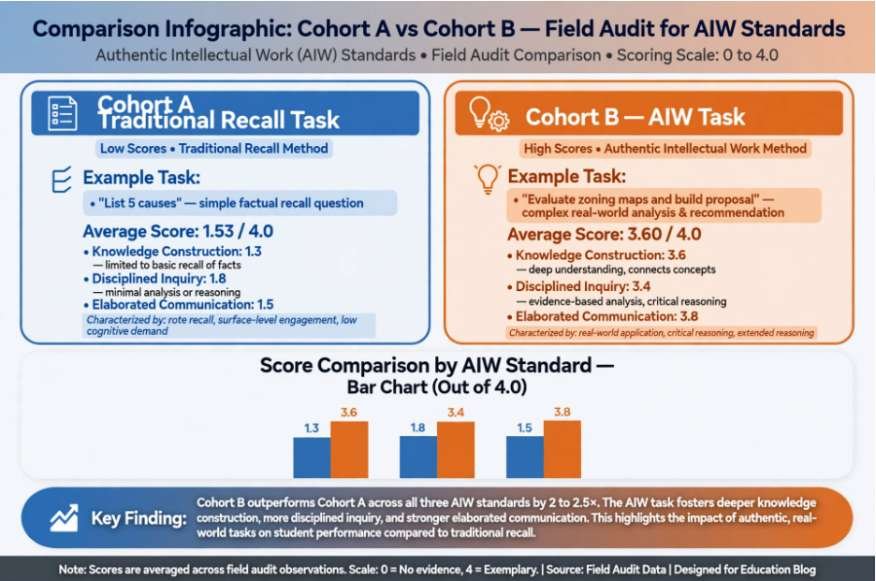
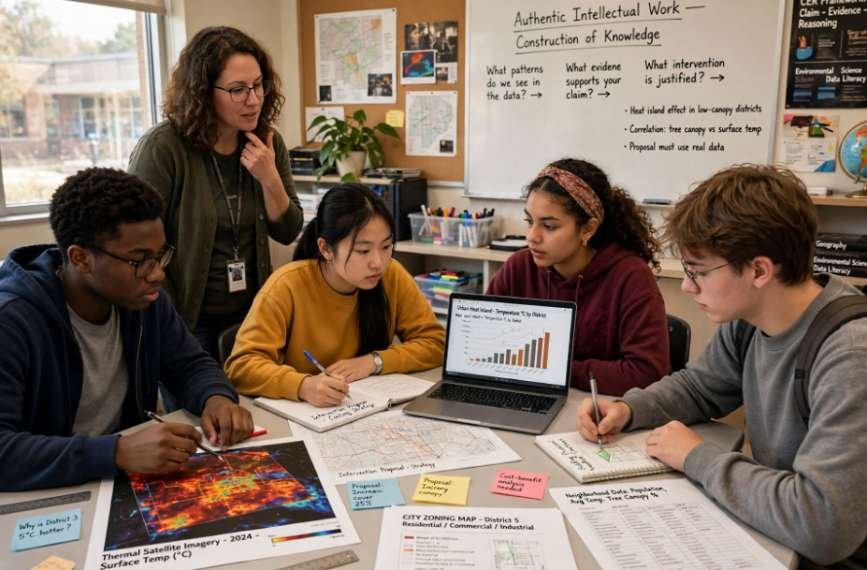
To test the impact of prompt design on student performance, I ran a departmental audit evaluating a ninth-grade environmental science unit across two instructional cohorts (48 students each).
Cohort A completed a traditional textbook assignment. Cohort B answered a prompt redesigned under AIW knowledge construction standards. We scored both student cohorts across the standard 1–4 AIW rubric scale.
| Evaluation Criterion | Cohort A (Traditional Recall Task) | Cohort B (AIW Knowledge Construction Task) |
| Initial Prompt Type | “List 5 causes of urban heat islands and describe two mitigation methods.” | “Evaluate zoning maps, tree-canopy surveys, and thermal satellite data to build an intervention proposal for our city council.” |
| Knowledge Construction Score | 1.3 / 4.0 (Heavy reproduction; low synthesis) | 3.6 / 4.0 (Extensive data synthesis; original solutions) |
| Disciplined Inquiry Score | 1.8 / 4.0 (Isolated definitions without context) | 3.4 / 4.0 (Correct use of thermodynamic and albedo concepts) |
| Elaborated Communication Score | 1.5 / 4.0 (Single-sentence bullet points) | 3.8 / 4.0 (Structured, evidence-backed proposal briefs) |
Cohort A submitted copied glossary definitions and superficial summaries. Cohort B engaged with local urban canopy percentages and surface temperature gradients to construct actionable policy proposals. The cognitive shift did not require longer class sessions; it required redesigning the prompt to demand higher-order thinking.
Ditch the Worksheets: Build Cognitive Muscle
Worksheets that prioritize easy grading over intellectual challenge produce passive learners. Authentic intellectual work standards for knowledge construction analysis provide a blueprint to break that habit.
Start your next curriculum audit with a single assignment. Remove the pre-structured fill-in-the-blank spaces. Provide raw data, primary documents, or contrasting perspectives, and ask your students to resolve the tension using disciplined reasoning. When students build understanding instead of borrowing it, retention, engagement, and critical thinking take care of themselves.
Frequently Asked Questions
1. What are authentic intellectual work standards for knowledge construction analysis?
They are evaluative criteria that measure how well assignments, instruction, and student work require learners to manipulate, synthesize, and interpret information to solve novel problems.
2. How does the AIW framework define higher-order thinking?
The framework defines it as transforming information and ideas through synthesizing, generalizing, explaining, or hypothesizing to arrive at original interpretations.
3. Why is knowledge construction insufficient on its own?
Knowledge construction must be paired with disciplined inquiry and real-world value to ensure novel ideas remain academically rigorous, empirically grounded, and personally meaningful.
4. What is the primary indicator of low knowledge construction in student work?
Work that relies entirely on reproduction, such as direct transcriptions, factual recall worksheets, and memorized answers without interpretation.