
Higher Order Thinking Strategies for Construction of Knowledge in Middle School
Middle schoolers do not lack critical thinking skills; they lack structured systems to pull those skills out of their heads. For years in my seventh-grade classroom, I watched bright twelve-year-olds recite flawless definitions of photosynthesis or democracy, only to freeze when asked how altering a single variable would collapse the entire system. Implementing higher order thinking strategies for construction of knowledge in middle school completely changes that dynamic. It bridges the gap between passive listening and active, independent discovery.
The Middle School Cognitive Shift: From Passive Retention to Active Construction
Middle school marks a volatile developmental window. Students sit directly on the cognitive threshold between Jean Piaget’s concrete operational stage and formal operational abstraction. They are shedding elementary habits of mechanical repetition, but their working memory remains fragile.
Why Rote Memorization Fails Young Adolescents
Memorization creates an illusion of competence. When we ask middle schoolers to regurgitate flashcard definitions, their brains treat facts as isolated artifacts. According to cognitive frameworks documented by Vanderbilt University’s Center for Teaching, genuine retention requires students to analyze, evaluate, and create rather than simply catalogue facts. Without deliberate synthesis, forgotten facts vanish the moment the Friday test concludes.
Jean Piaget Meets Modern Neuroscience in Grades 6–8
Adolescent brains undergo intensive synaptic pruning and prefrontal cortex development. As published in foundational educational studies cataloged by the Institute of Education Sciences, young adolescents require tangible, structured bridges to cross into abstract logic. They cannot construct stable mental models out of thin air. They require concrete scaffolding that forces them to manipulate, categorize, and challenge information.
3 Core Frameworks That Propel Knowledge Construction
Moving students past basic recall requires three interdependent instructional pillars. When woven into daily instruction, these models form an intellectual engine that empowers students to synthesize raw information into lasting comprehension.
Teachers can strengthen these instructional approaches through elementary teacher professional development for construction of knowledge, gaining practical strategies to help younger learners move beyond memorization and develop deeper conceptual understanding.
+——————————————————————-+
| Intentional Questioning Framework |
| 1. Establish Causality –> 2. Prioritize –> 3. Ground Claims|
+——————————————————————-+
|
v
+——————————————————————-+
| Strategic Schema Building |
| Hierarchical Concept Maps + QAR Frameworks |
+——————————————————————-+
|
v
+——————————————————————-+
| Metacognitive Modeling & Articulation |
| Mind Movies + Thinking Inventories + Sentence Frames |
+——————————————————————-+
Intentional Inquiry: The 3-Step Questioning Progression
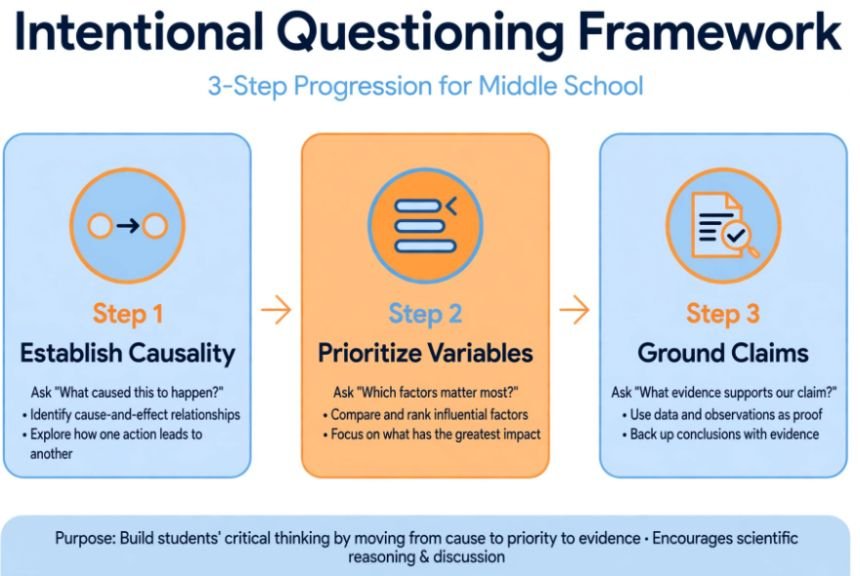
Traditional classroom questioning settles for low-level identification. A teacher asks what happened, and a student repeats a sentence from page 42. True knowledge construction begins when you ban surface-level identification and adopt an intentional three-tier sequence:
- Establish Causality: Ask why or how a phenomenon occurred to expose the mechanical relationships beneath events.
- Prioritize Variables: Ask students to identify which single factor was the most critical tipping point, forcing them into comparative evaluation.
- Ground Claims: Demand that students identify explicit, verifiable evidence that proves their chosen factor outranks competing variables.
I routinely lean on this sequence when designing classroom assignments. It eliminates surface guesses and forces students to defend the internal logic of their ideas.
Structured Schema Building and Relational Mapping
Schema construction is the physical act of connecting new input to established mental scaffolding. If a student cannot organize ideas structurally, cognitive overload shuts down processing.
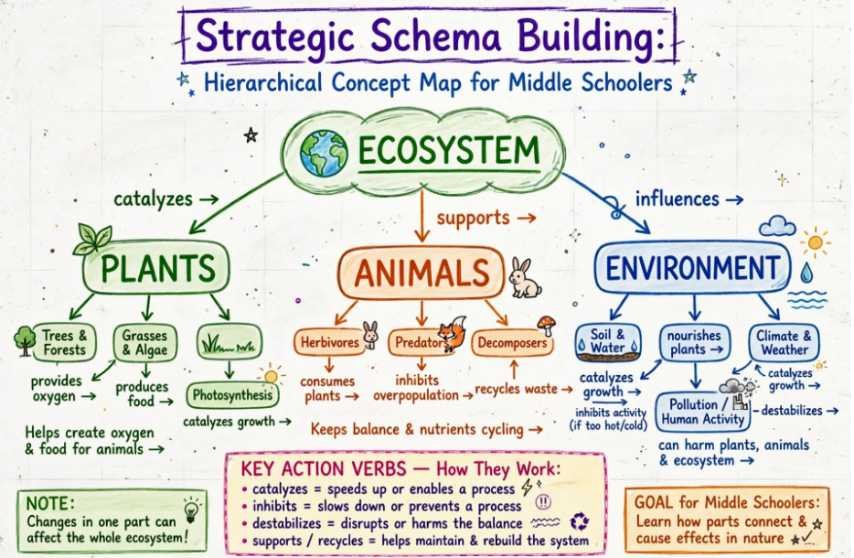
- Hierarchical Concept Mapping: Mind maps that force students to rank concepts from broad systems down to localized mechanisms prevent fragmented understanding. When students draw physical arrows labeled with action verbs (e.g., destabilizes, catalyzes, inhibits), they expose relational dependencies.
- Question-Answer Relationships (QAR): Introduced across literacy research supported by ASCD, QAR trains learners to separate questions into “In the Book” (direct retrieval) and “In My Head” (synthesis and evaluation). This distinction teaches middle schoolers to select the right mental gear before tackling a prompt.
Metacognitive Modeling and Scaffolded Autonomy
Middle schoolers frequently experience cognitive friction because they cannot inspect their own thought processes. Metacognition turns internal confusion into actionable strategy.
- Structured “Mind Movies”: When introducing dense processes—like atmospheric circulation or the ratification of a treaty—prompt students to visualize a five-second sequence. Having them storyboard this internal picture reveals immediate gaps in their conceptual mechanics.
- Thinking Inventories: At the start of a unit, assign three predictive prompts that have no simple answer. Revisit these exact sheets mid-unit and post-unit. Require students to document how and why their conclusions shifted.
- Low-Stakes Articulation Tools: Reluctant students often possess profound insights but lack the linguistic architecture to articulate them. Sentence stems provide that support without diluting the intellectual rigor.
A Field-Tested Classroom Protocol: The Yellowstone Ecosystem Shift
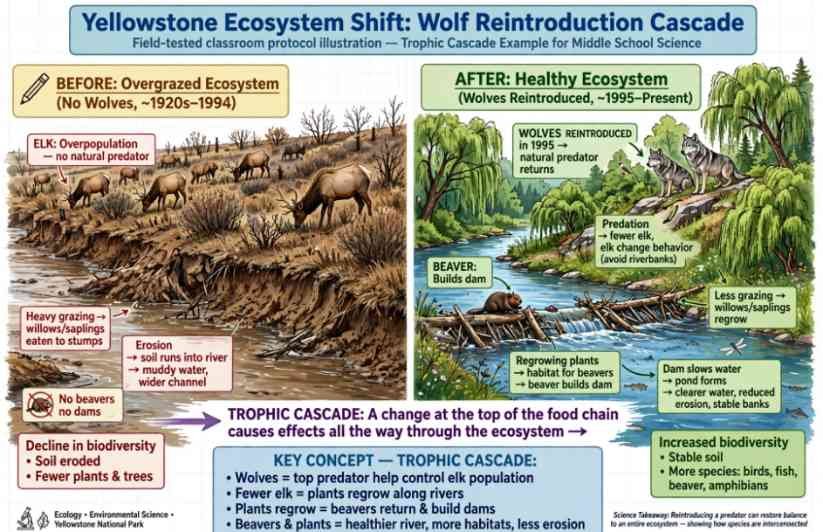
To evaluate how these strategies work in practice, consider an ecology unit examining the reintroduction of wolves to Yellowstone National Park.
| Inquiry Phase | The Question Prompt | Cognitive Task Required | Student Knowledge Construction |
| Step 1: Causality | How did the reduction of riverbank willows lead to the collapse of local beaver colonies? | Analyze cascading ecological mechanisms. | Links herbivore overgrazing directly to raw materials required for dam architecture. |
| Step 2: Prioritizing | Was overgrazing by elk or seasonal flooding the primary tipping point for bank erosion? | Evaluate competing environmental variables. | Weighs vegetative root tensile strength against hydrologic forces. |
| Step 3: Grounding | What quantitative data from the soil runoff logs confirms your claim? | Ground conclusions in primary empirical data. | Cites exact sediment volume decreases following predator recovery. |
Instead of grading this exercise with a generic completion check, I evaluate progress using targeted rubrics for evaluating student construction of knowledge. This diagnostic approach measures whether a student merely recited textbook trivia or actually mapped system-level relationships.
Removing Barriers: Scaffolding Complex Reasoning for Reluctant Learners
When introducing demanding analytical challenges, intermediate-grade students occasionally retreat behind claims of confusion. In my experience, this resistance rarely reflects intellectual inability. Instead, it reflects an overloaded working memory.
According to developmental guidance shared by the Association for Middle Level Education, middle school educators must isolate the analytical challenge from the expressive challenge. Provide structural frames such as:
“While evidence shows that [Alternative Factor] influenced the outcome, [Primary Factor] was ultimately more critical because…”
This scaffolding liberates the student to dedicate their cognitive bandwidth to evaluating evidence rather than wrestling with syntactic phrasing. Over time, fade the prompt stems as students internalize the underlying logical architecture.
Frequently Asked Questions
1. What are higher order thinking strategies in middle school?
They are instructional methods—including causal questioning, schema mapping, and metacognitive tracking—that guide adolescents to analyze, evaluate, and create new understanding.
2. How do questioning progressions support knowledge construction?
They move students step-by-step from surface recall to variable prioritization and evidence-based defense.
3. Why is schema mapping critical for middle school students?
It organizes complex abstractions into visible, interconnected hierarchies that prevent working memory overload.
4. How can teachers scaffold higher order thinking for struggling readers?
Provide low-stakes sentence stems and concept templates so students can focus cognitive energy on analysis rather than sentence construction.
Ditch the Lecture and Build the Scaffolding
If your classroom relies on students quietly copying whiteboard bullet points, you are carrying cognitive weight that belongs to them. Deep knowledge cannot be gifted; it must be constructed piece by piece through productive cognitive struggle.
Select one lesson this week. Replace your introductory review with a three-step causal question, supply a simple relational concept map, and step back. Watch your students transform from passive note-takers into genuine analysts who own their understanding.