
Elementary Teacher Professional Development for Construction of Knowledge
When I spent seven straight hours in an airless school cafeteria listening to a slide deck explain “active learning,” the irony was palpable. The presenter lectured on how young children need to build concepts through physical manipulation and social dialogue, yet treated fifty experienced educators like passive tape recorders. That disconnect explains why traditional workshops fail our classrooms.
Designing genuine elementary teacher professional development for construction of knowledge requires throwing out the top-down lecture model entirely. If we expect seven-year-olds to hypothesize, experiment, and articulate their mental schemas, our adult training models must mirror that exact cognitive architecture.
The Transmission Trap in Early Elementary Classrooms
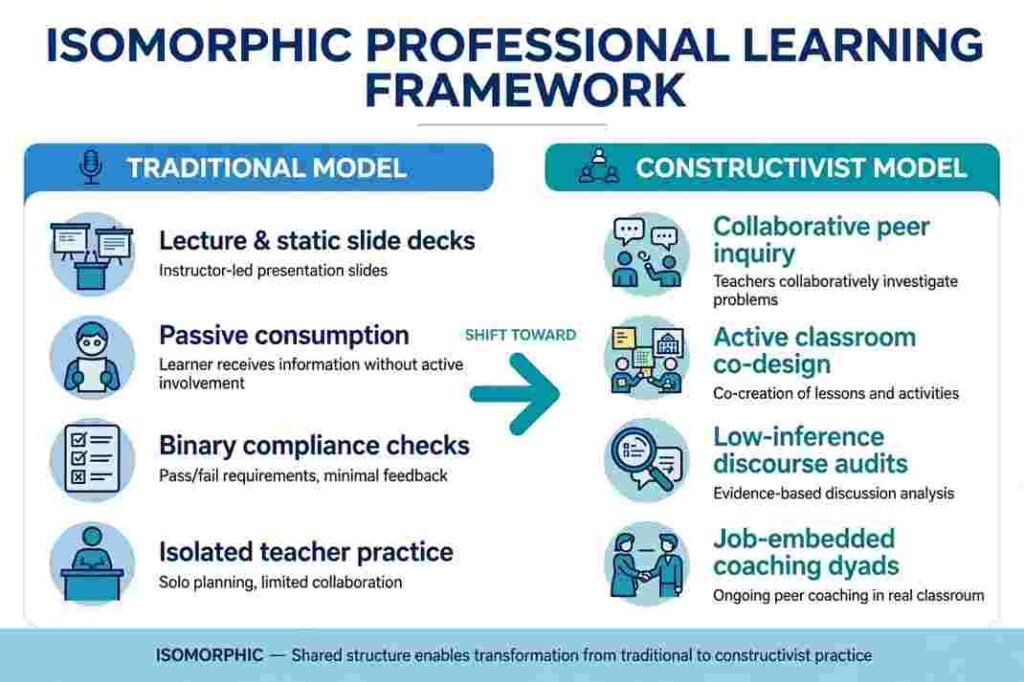
Most elementary schools still run on intellectual transmission. The instructor owns the facts, models a procedure, and monitors whether students can duplicate it. This system rewards rote memorization while starving conceptual reasoning.
Traditional Delivery Model:
Teacher (Source of Truth) —> Direct Modeling —> Rote Duplication (Binary Evaluation)
Constructivist Delivery Model:
Driving Phenomenon/Task —> Cognitive Dissonance —> Peer Discourse —> Co-Constructed Schema
Why Passive Workshops Create the “Know-Do” Gap
School districts routinely invest tens of thousands of dollars in off-site seminars. Teachers take notes, return to their rooms on Monday, and immediately revert to teacher-led recitations. The issue is not teacher resistance; it is cognitive isolation.
Constructing new instructional strategies requires regular trial, cognitive dissonance, and collaborative reflection. Without immediate feedback loops during real instructional blocks, adult learners drop complex methods in favor of familiar, scripted direct instruction.
The Cognitive Mechanics of Active Sense-Making
Early childhood learning hinges on navigating cognitive dissonance. In Piagetian terms, a learner must encounter a situation that their current mental model cannot resolve. Developmentally appropriate practices detailed by the National Association for the Education of Young Children (NAEYC) emphasize that children internalize concepts when they manipulate physical tools and negotiate meanings with peers.
When a first grader balances weights on a seesaw, they are not memorizing physics formulas. They are revising their intuitive schemas about mass, distance, and equilibrium. Adults learn instructional agility through the exact same psychological processes.
Designing Isomorphic Professional Learning Communities
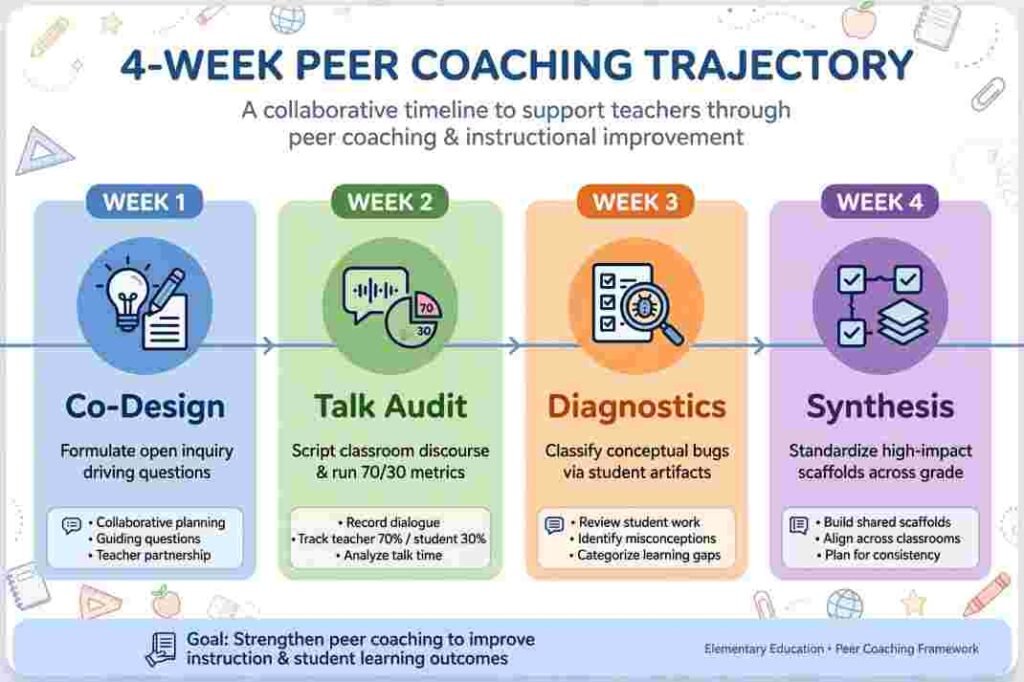
Sustainable instructional changes happen when the medium matches the message. Professional learning communities (PLCs) must operate as constructivist laboratories where teachers co-design, test, and critique tasks together.
4-Week Peer Coaching Trajectory
| Week | Focus | Activity |
| Week 1 | Co-Design | Formulate open inquiry driving questions |
| Week 2 | Talk Audit | Script classroom discourse & run 70/30 metrics |
| Week 3 | Diagnostics | Classify conceptual bugs via student artifacts |
| Week 4 | Synthesis | Standardize high-impact scaffolds across grade |
Structuring Grade-Level Inquiry Dyads
Rather than running generic department-wide meetings, I pair educators into grade-level coaching dyads. These pairs do not trade surface-level advice. They identify a single conceptual sticking point in their upcoming curriculum—such as decomposing numbers into tens and ones or understanding plant transpiration—and co-design an open-ended inquiry task.
Through structured professional development for construction of knowledge, teachers map the learning journey using the Gradual Release of Responsibility. Direct instruction shrinks to a brief launch, passing the cognitive load to peer collaboration.
Moving Beyond Direct Answers in Professional Dialogue
During peer planning sessions, coaches avoid handing out pre-packaged solutions. When a second-grade teacher remarks that their students cannot grasp regrouping across zeros, the coach does not hand over a worksheet. Instead, they examine the student work together.
The coach poses a diagnostic prompt: “What does this representation reveal about the child’s spatial understanding of place value?” The teacher formulates the diagnosis, tests interventions with base-ten blocks, and evaluates the outcome.
Field-Tested Protocols for Classroom Knowledge Building
Transitioning from a didactic classroom to an authentic constructivist environment requires specific micro-routines. Teachers need tangible scripts to replace instinctive habits of direct correction.
Shifting from Verification to Diagnostic Elicitation
The most common classroom reflex is affirming correct answers and immediately correcting wrong ones. This habit short-circuits thinking. When an educator verifies an answer, cognitive evaluation ends.
Avoid Verification Prompts:
Teacher: “Is 4/8 greater than 1/2?”
Student: “Yes.”
Teacher: “No, they’re equal. Remember the rule?” (Thinking terminates)
Implement Diagnostic Elicitation:
Teacher: “Show me how 4/8 and 1/2 look on your number line.”
Student: “They land in the same place.”
Teacher: “What makes them share that exact spot?” (Thinking deepens)
By leaning into thinking routines documented by Harvard Project Zero, teachers learn to substitute confirmation with diagnostic prompts:
- “What makes you say that?”
- “Can someone build on or challenge that reasoning?”
- “Where on your model does that idea show up?”
These questions compel elementary students to verbalize their inner logic, allowing peers to spot inconsistencies collaboratively.
The 70/30 Discourse Audit
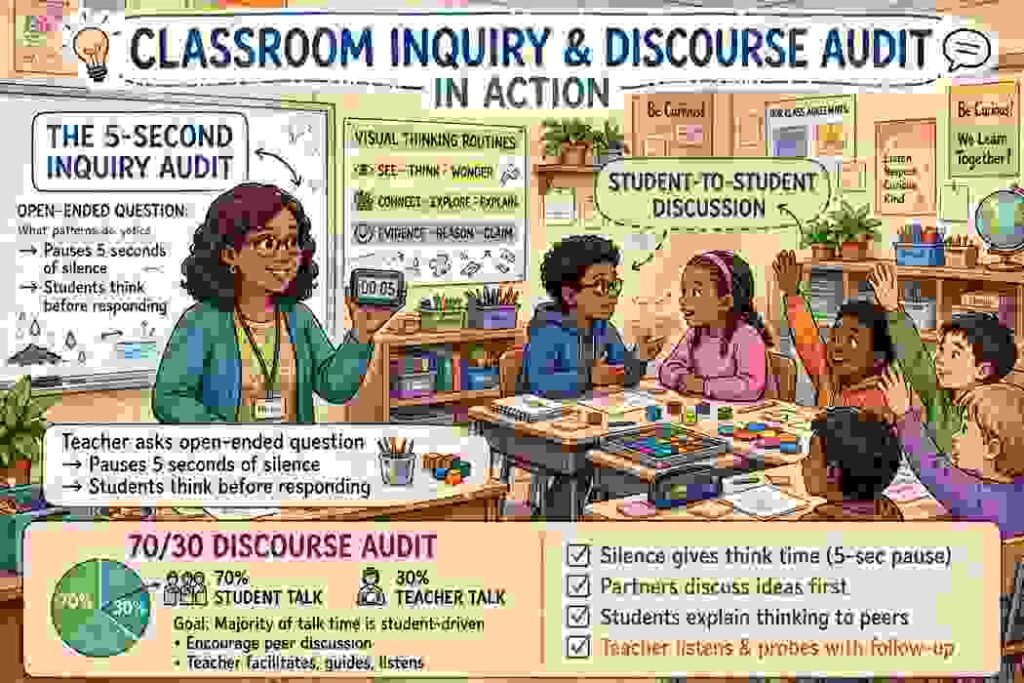
During classroom observation rounds, I run an objective discourse tracking tool. For twenty minutes of small-group investigation, I record every speaker transition using a low-inference script.
DISCOURSE AUDIT METRIC:
– Student-to-Student Talk: >= 70% of total session dialogue
– Teacher Prompt/Wait Time: <= 30% of total session dialogue
– Teacher Interventions: Limited to non-evaluative probes
In classrooms successfully executing authentic inquiry models highlighted by Edutopia, the teacher speaks less than a third of the time. When teachers see their talk metrics plotted visually, the feedback is immediate. Most realize their explanations were crowding out student exploration.
Measuring Conceptual Growth Without Multiple-Choice Quizzes
Standardized bubble tests rarely measure deep conceptual development. They measure memory retrieval under pressure. A child can easily memorize that 34=12 without understanding that multiplication represents equal groups or arrays.
Comprehensive construction of knowledge aiw frameworks emphasize using student-generated artifacts as primary assessment evidence. During our grade-level reviews, we evaluate:
- Student Explanatory Sketches: Can the child create a multi-step visual diagram representing their solution path?
- Recorded Verbal Rationales: Audio snippets captured during peer problem-solving displaying conceptual clarity.
- Iterative Error Corrections: Portfolios showing how a child modified an initial incorrect hypothesis after testing it against a physical model.
Ditch the Sit-and-Get: Your Monday Action Plan
Dumping three-ring binders of instructional theory onto teachers changes nothing. Real pedagogical evolution occurs through small, deliberate micro-shifts inside actual classrooms.
+————————————————————————+
| THE 5-SECOND INQUIRY AUDIT |
+————————————————————————+
| Step 1: Deliver an open-ended question. |
| Step 2: Mentally count five full seconds without speaking. |
| Step 3: Direct the initial response to another student for evaluation. |
| Step 4: Record how many children jump into the dialogue unprompted. |
+————————————————————————+
Start tomorrow morning with a single lesson. Turn your next direct-instruction sequence into a puzzle. Hand out manipulatives before explaining the formula, set up your timer for five seconds of uninterrupted silence after every question, and let your students wrestle with the challenge. When you stop giving away the answers, your classroom transforms into a community of real thinkers.
Frequently Asked Questions
1. What is the core goal of elementary constructivist professional development?
It equips teachers to facilitate active inquiry, student-led discourse, and conceptual problem-solving rather than rote fact delivery.
2. How does social constructivism appear in an elementary classroom?
Students talk through mathematical reasoning, debate hypotheses in science, and collaborate in heterogeneous groups to build shared meaning.
3. Why do traditional lecture-based PD workshops fail elementary teachers?
They treat educators as passive consumers, failing to provide the job-embedded coaching and feedback needed to change daily habits.
4. How can elementary teachers assess knowledge construction without tests?
By analyzing explanatory drawings, evaluating student dialogue transcripts, and reviewing student portfolios tracking revisions over time.