Professional Development for Construction of Knowledge in High School: A Practical Implementation Blueprint
When I stepped into high school instructional coaching after a decade of teaching secondary physics, I watched brilliant educators burn out attempting constructivist pedagogies. They sat through inspirational August keynotes, filled out graphic organizers, and returned to their classrooms determined to facilitate deep student inquiry.
By October, every single one of them was back behind the podium deliver-lecturing slide decks to exhausted teenagers. Traditional workshops fail because they demand teachers facilitate complex student-led inquiry without ever experiencing it themselves. Building sustained professional development for construction of knowledge in high school requires treating teachers as cognitive architects rather than delivery couriers.
The Breakdown of the Conventional Workshop Model
Traditional secondary teacher training operates on an antiquated industrial framework. High schools pay external consultants substantial fees to deliver ninety-minute presentations in packed auditoriums. Administrators check off compliance mandates, yet classroom practice remains entirely unchanged.
Why the 5% Transfer Rate Persists in Secondary Schools
Educational research from institutions like Learning Forward confirms that isolated one-off training produces less than a five percent transfer rate to daily practice. When training formats rely solely on passive compliance, educators mirror that exact behavior in their classrooms.
High school teachers navigate high-stakes Advanced Placement, International Baccalaureate, and state graduation benchmarks. Under that pressure, training sessions that lack live classroom modeling, iterative feedback loops, and peer observation get discarded the instant the opening bell rings.
Breaking the Grip of the Pacing Guide Paradox
The largest obstacle standing between high school teachers and student knowledge construction is the pacing guide paradox. Educators constantly face a false dichotomy: cover every standard superficially via rapid lectures, or facilitate deep student inquiry and fall weeks behind district mandates.
Lecturing serves as an understandable survival mechanism. It gives teachers the illusion of control and guarantees that every curriculum objective was technically “covered” before exam season. Overcoming this barrier requires structured professional learning that teaches faculty how to streamline factual memorization so they can preserve instructional windows for conceptual wrestling.
Designing Constructivist Professional Learning Communities
When our instructional team shifted our professional learning communities (PLCs) toward constructivist principles, we stopped using meeting times for administrative announcements. We transformed department meetings into laboratory spaces where teachers analyzed authentic student work samples and examined instructional discourse.
Grounding Classroom Shifts in Authentic Intellectual Work
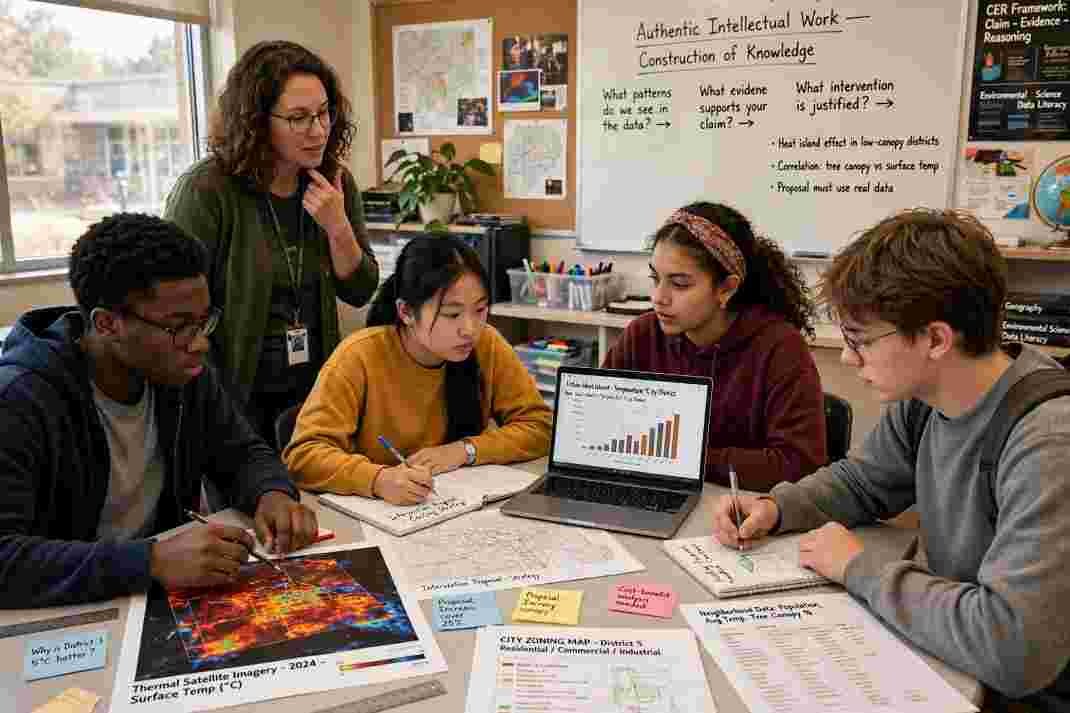
To prevent active learning from degenerating into unstructured activities, training must rely on clear evaluation standards. We anchor our departmental rubrics in Newmann’s research on authentic intellectual work. Authentic learning requires moving past simple information recall toward higher-order synthesis and disciplined inquiry.
High school assignments must demand that students organize, interpret, evaluate, and transform existing knowledge rather than simply regurgitate memorized formulas. Addressing the transition away from reproduction in authentic learning requires regular professional learning reviews. During these audits, instructional coaches evaluate student tasks directly against the foundational construction of knowledge aiw criteria to ensure students analyze raw data, critique primary documents, and construct original arguments.
The 70/30 Curriculum Decoupling Protocol
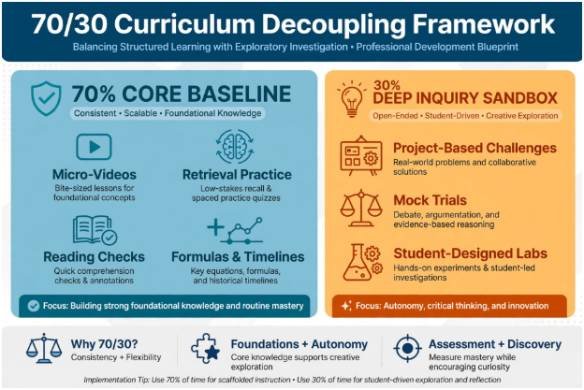
During our secondary curriculum review, our instructional team developed the 70/30 Curriculum Decoupling Framework. This approach splits the pacing calendar into two functional zones:
- The 70% Core Baseline: Seventy percent of the curriculum consists of discrete foundational terms, basic formulas, and introductory historical timelines. We train teachers to offload these basics through short, targeted flipped micro-videos, retrieval practice, and self-graded reading checks.
- The 30% Deep Inquiry Sandbox: By streamlining basic knowledge transmission, teachers recover instructional hours each unit. They dedicate this protected thirty percent exclusively to project-based challenges, historical mock trials, and student-designed laboratory experiments.
This operational split directly eliminates the fear of falling behind district timelines. Teachers maintain their curriculum pacing while protecting classroom time for rigorous cognitive construction.
Core Instructional Strategies That Drive Student Knowledge Construction
Professional development initiatives must move past abstract academic theory and train educators on explicit classroom routines. Teachers need repeatable instructional moves that systematically dismantle learned student passivity.
+——————————————————————————–+
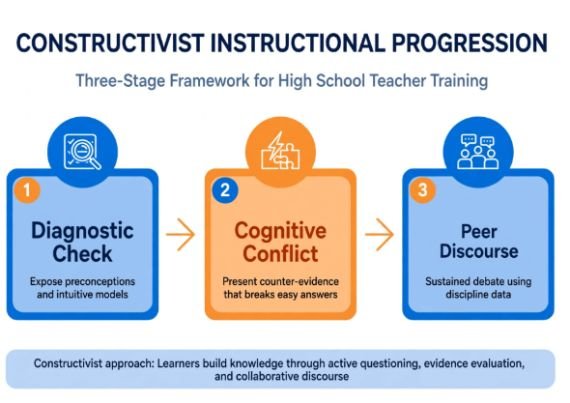
| CONSTRUCTIVIST INSTRUCTIONAL PROGRESSION |
+——————————————————————————–+
| |
| [ Diagnostic Check ] –> [ Cognitive Conflict ] –> [ Peer Discourse ] |
| Expose preconceptions Present counter-evidence Sustained debate |
| and intuitive models that breaks easy answers using discipline data |
| |
+——————————————————————————–+
Cognitive Scaffolding and Diagnostic Pre-Testing
Knowledge construction does not happen in a vacuum; it requires linking new information to existing mental schema. Effective professional development programs instruct teachers on how to deploy cognitive scaffolding techniques that unearth student misconceptions early:
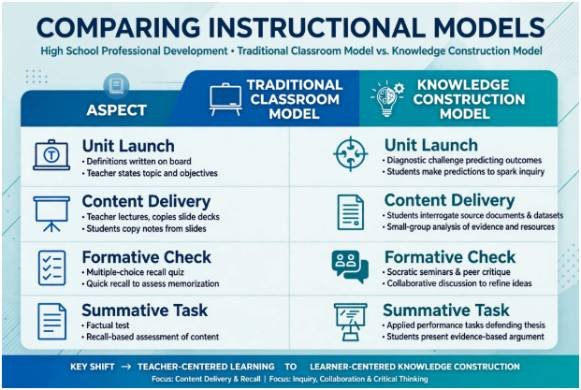
| Instructional Stage | Traditional Classroom Model | Knowledge Construction Model |
| Unit Launch | Teacher writes definitions on board and lectures. | Diagnostic challenge asking students to predict real-world outcomes. |
| Content Delivery | Students copy slide decks into notebooks. | Students interrogate contrasting source documents and raw datasets. |
| Formative Check | Multiple-choice recall worksheets. | Socratic seminars, peer critique, and model revisions. |
| Summative Task | End-of-unit factual multiple-choice test. | Applied performance tasks defending a validated thesis. |
Teachers learn to leverage resources curated by the IES What Works Clearinghouse to design high-leverage questioning sequences that keep the cognitive burden on students.
Maker-Centered Inquiries and Cross-Disciplinary Design
High school students internalize abstract concepts faster when they build, test, and revise tangible representations of those ideas. Drawing upon documentation from Harvard Project Zero, our training sessions immerse educators in maker-centered inquiries.
For instance, an environmental science teacher and a modern world history teacher co-designed a combined urban ecology project. Students gathered local watershed drainage readings, correlated those metrics with historic municipal redlining zoning maps, and presented policy briefs to city council members. Because both teachers had actively worked through an interdisciplinary planning protocol during their summer institute, they guided student inquiries smoothly without taking over the problem-solving process.
Implementing Sustainable Coaching and Peer Lesson Studies
Sustainable school-wide transformation requires continuous classroom support. High schools must transition from evaluative drop-in walkthroughs to non-punitive, collaborative lesson studies supported by peer coaching models validated by organizations like ASCD.
Our academic departments adopt a structured three-week lesson study cycle:
+—————————————————————————–+
| THREE-WEEK LESSON STUDY CYCLE |
+—————————————————————————–+
| |
| [ Week 1: Co-Design ] Teachers build inquiry tasks and predict pitfalls. |
| | |
| v |
| [ Week 2: Observation ] One teacher hosts while peers track discourse data.|
| | |
| v |
| [ Week 3: Refinement ] Team reviews student work and adjusts the lesson. |
| |
+—————————————————————————–+
During classroom observations, observers track clear verbal interaction patterns. They record who asks questions, how long the teacher waits after speaking, and whether student responses build on peer observations. If the teacher talks for more than thirty percent of the class period, the team reconvenes to restructure the lesson scaffolds.
Ditch the Podium: Actionable Next Steps for Department Heads
Shifting high school faculties away from passive lecturing requires patience, structural administrative backing, and continuous peer support. If your department is ready to replace passive compliance with rigorous knowledge construction, implement these immediate actions tomorrow:
- Audit Department Assessments: Review your upcoming quarterly exams and convert at least twenty percent of recall questions into data interpretation tasks.
- Reclaim Meeting Agendas: Eliminate email-level administrative logistics from weekly department gatherings and dedicate that time to student work reviews.
- Institute a Peer Door-Opening Policy: Pair teachers across related disciplines to observe one thirty-minute student inquiry lesson each month.
- Deploy the 70/30 Rule: Identify the non-negotiable power standards in your curriculum guide and isolate supporting facts for quick flipped review.
Step away from the lecture podium and let your students take ownership of their learning.
Frequently Asked Questions
1. What does construction of knowledge mean in a high school setting?
It means students analyze, evaluate, and synthesize raw evidence to build new understandings instead of passively copying facts.
2. How do constructivist classrooms maintain state test pacing?
By shifting basic definitions to pre-class reading, teachers preserve dedicated class periods for deep inquiry into complex power standards.
3. Why do high school students often resist active learning?
Students grow accustomed to passive listening; productive cognitive struggle creates initial discomfort that requires clear teacher scaffolding.
4. What is the most effective format for secondary professional learning?
Collaborative lesson studies and non-evaluative instructional coaching that model active learning using authentic student work.