Disciplined Inquiry and Construction of Knowledge AIW Criteria: A Field Guide
When I spent my first year auditing district curriculum rubrics, I watched exceptional teachers assign tasks that kept students quiet, busy, and compliant. The students produced pages of pristine writing, yet the intellectual yield was remarkably shallow. Evaluating assignments against the disciplined inquiry and construction of knowledge aiw criteria fundamentally changes that paradigm. Fred Newmann and his research colleagues designed Authentic Intellectual Work (AIW) not as a cosmetic scoring sheet, but as a framework to dismantle passive rote memorization.
Understanding this framework requires looking directly at how students handle complex cognitive demands. The criteria target authentic intellectual output rather than routine regurgitation.
The Breakdown: Why Most Rigorous Tasks Fail in Practice
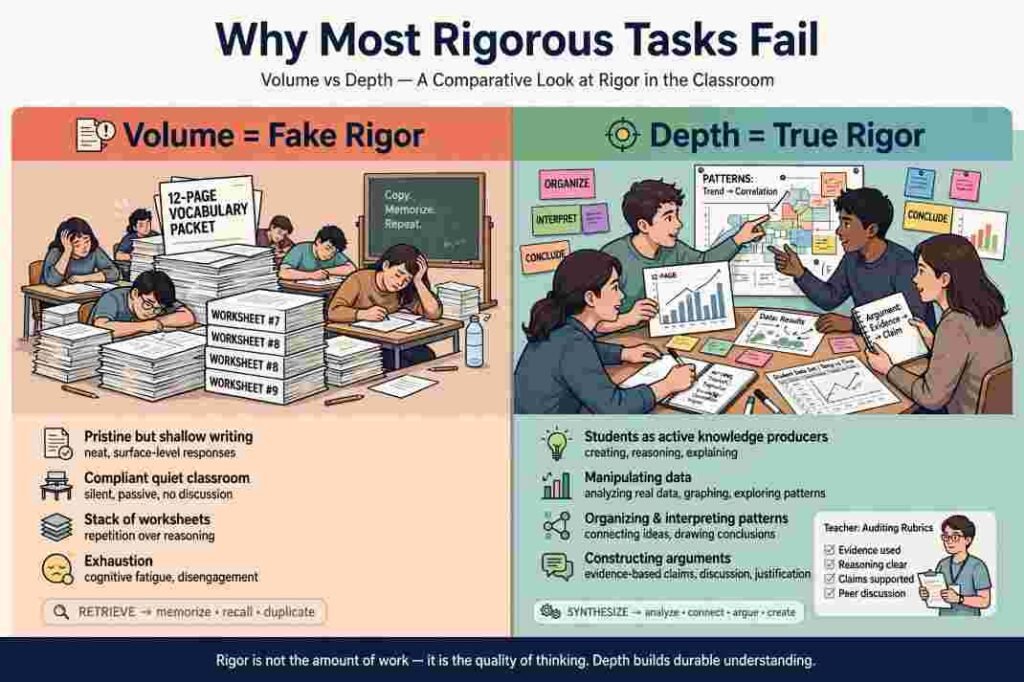
Classroom tasks often mimic difficulty by increasing volume rather than cognitive depth. A twelve-page packet of vocabulary definitions is exhausting, but it requires almost zero original cognitive architecture. AIW counters this trap by demanding that assignments blend two interdependent mechanics: cognitive generation and disciplinary boundaries.
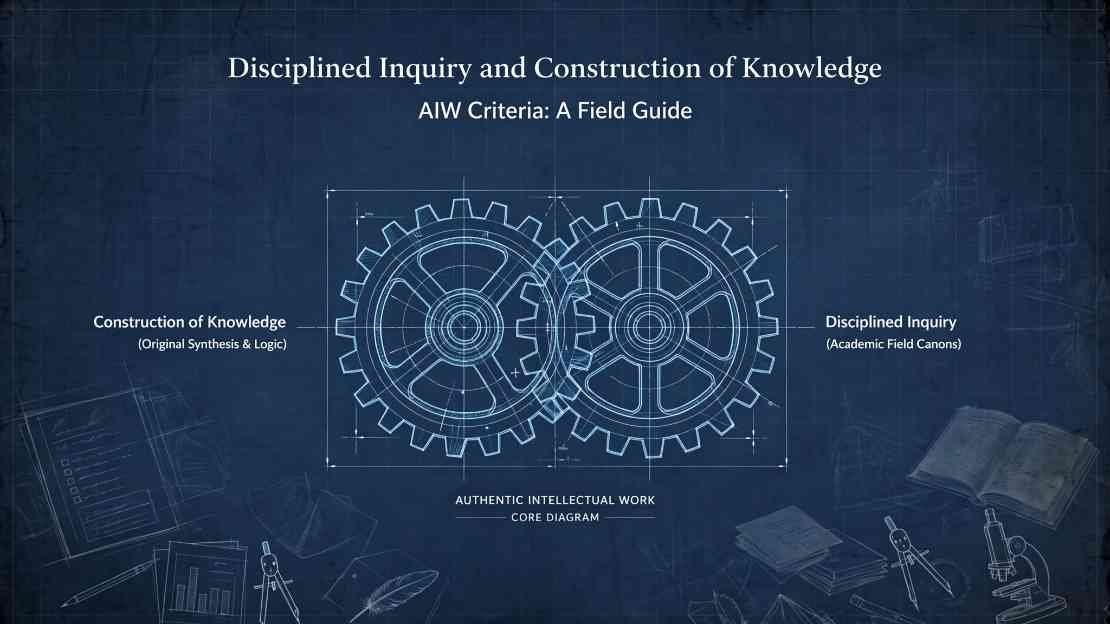
+————————————————————–+
| AUTHENTIC INTELLECTUAL WORK (AIW) CORE |
| |
| [ Construction of Knowledge ] <—> [ Disciplined Inquiry ] |
| (Original Synthesis & Logic) (Academic Field Canons) |
+————————————————————–+
Construction of Knowledge Demands Cognitive Synthesis
The construction of knowledge criterion assesses whether an assignment requires students to manipulate, organize, interpret, evaluate, or synthesize information. When I evaluate a task rubric, I look for where original thinking happens. If students merely copy pre-digested answers from a textbook chapter, cognitive construction is absent.
Students must act as active knowledge producers. They need to generate new meanings, identify non-obvious patterns, compare alternative hypotheses, and construct valid arguments to resolve an unfamiliar problem.
Disciplined Inquiry Anchors Rigor to Disciplinary Canons
Construction without discipline produces speculative, unsubstantiated opinion. Disciplined inquiry provides the boundary conditions. It forces novel student thinking to adhere to the rigorous standards, evidentiary rules, and conceptual tools of an established field.
According to foundational research published via the Institute of Education Sciences, students who learn under authentic intellectual criteria achieve significant, measurable gains across standardized assessments compared to peers in traditional classrooms. Unstructured brainstorming does not meet this threshold; systematic academic reasoning does.
The Three Pillars of Disciplined Inquiry Evaluated
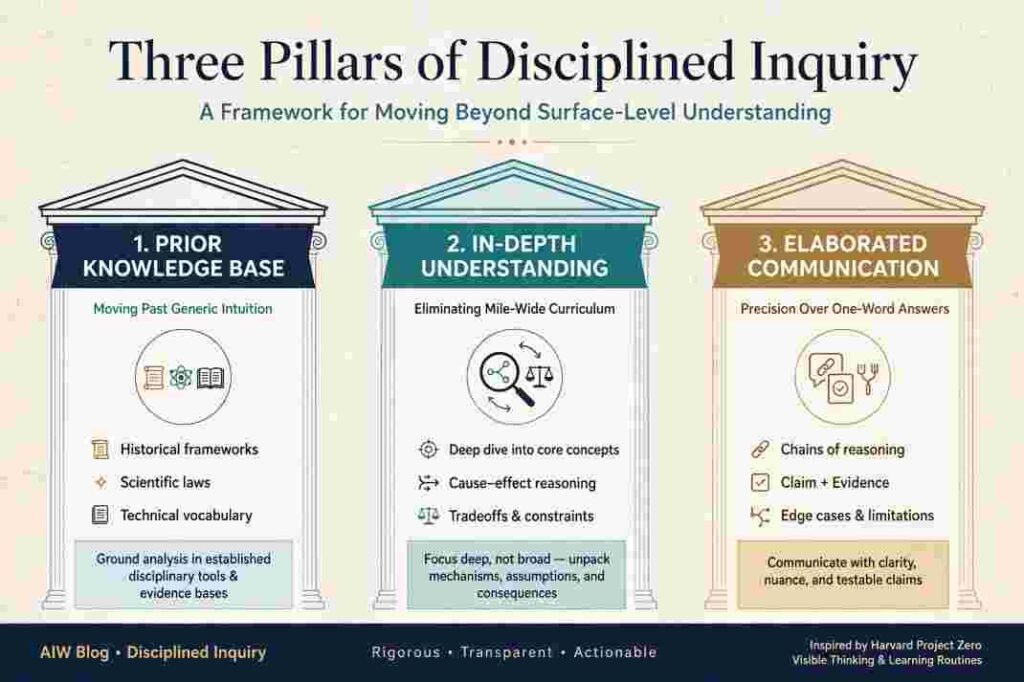
Disciplined inquiry breaks down into three distinct operational criteria. During rubric calibration sessions, my teams score each component independently to identify structural weaknesses in assignment prompts.
1. Prior Knowledge Base: Moving Past Generic Intuition
Inquiry must anchor directly to a defined discipline—history, biology, literary criticism, or applied mathematics. A high-scoring prompt requires students to correctly apply established algorithms, technical vocabulary, historical frameworks, or scientific laws.
Students cannot fall back on casual heuristics or conversational common sense. They must demonstrate fluency with the tools developed by professionals in that academic domain, as highlighted by frameworks developed at the Harvard Graduate School of Education Project Zero.
2. In-Depth Understanding: Eliminating the Mile-Wide Curriculum
Curriculum pacing guides frequently push teachers into an inch-deep survey of disconnected facts. In-depth understanding penalizes this surface coverage.
Tasks meet this criterion when they target the central concepts of a subject. Students explore nuances, analyze cause-and-effect relationships, weigh tradeoffs, and systematically test hypotheses. The assignment must push the student to grasp how core concepts connect, rather than asking them to memorize isolated milestones.
3. Elaborated Communication: Precision Over One-Word Answers
Authentic work demands coherent, detailed, and sustained exposition. Students must express their findings using sophisticated verbal, mathematical, or visual tools.
Elaborated communication requires complete chains of reasoning. Students must state a claim, supply disciplinary evidence, qualify edge cases, and articulate explicit causal links. Fill-in-the-blank responses, generic multiple-choice questions, and bulleted sentence fragments fail this benchmark instantly.
Real Task Transformation: A Direct Audit Example
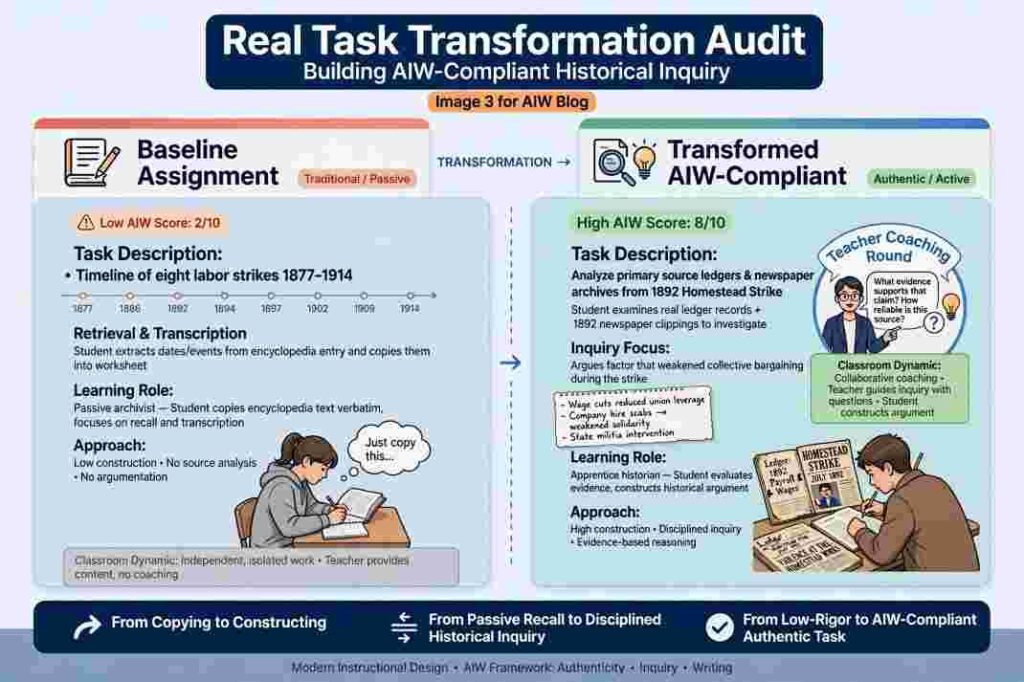
During a recent coaching round with a high school social studies department, we evaluated an existing assignment covering the American Industrial Era. The original task scored near the bottom of our AIW scoring bands. We systematically restructured the assignment prompt to satisfy the authentic intellectual work construction standards.
| Evaluation Metric | Baseline Assignment Prompt | Transformed AIW-Compliant Assignment Prompt |
| Assignment Prompt | “Create a timeline of eight major labor strikes between 1877 and 1914. List the dates, leaders, and primary outcomes.” | “Analyze primary source ledgers and newspaper archives from the 1892 Homestead Strike. Argue which factor most weakened collective bargaining: state military intervention or executive messaging control.” |
| Cognitive Mechanism | Retrieval and chronological transcription. | Direct historical synthesis, sourcing critique, and comparative causal evaluation. |
| AIW Scoring Yield | Low Construction; Low Disciplined Inquiry. | High Construction; High Disciplined Inquiry; Elaborated Written Defense. |
The transformed task shifts the student from a passive archivist to an apprentice historian. The student cannot lift an answer directly from an encyclopedia entry. They must process raw historical records, apply historical methods, and defend an original position using disciplined evidence.
Operationalizing Scoring Across Task, Instruction, and Student Output
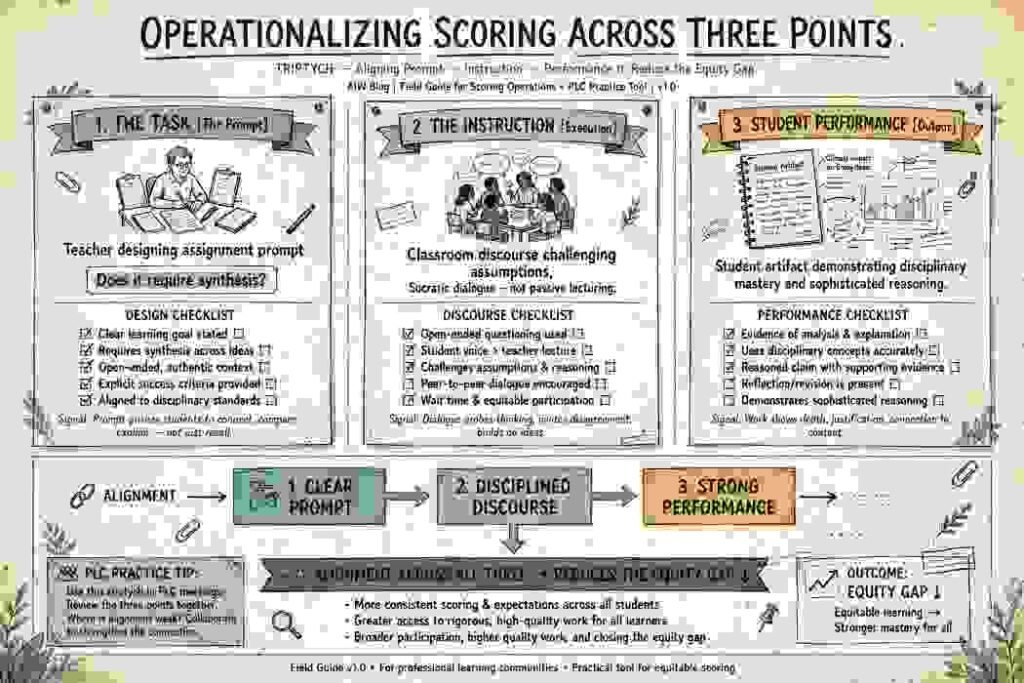
A common mistake in professional learning communities is evaluating student papers without auditing the assignment prompt itself. When analyzing academic environments through AIW standards documented by the National Center on Secondary Education and Transition, effective schools score three distinct intervention points:
- The Task (The Prompt): Does the teacher’s assignment explicitly require high-order synthesis and disciplinary inquiry? If the prompt merely asks for a plot summary, even brilliant students cannot produce high-level authentic work.
- The Instruction (The Execution): Does classroom discourse challenge student assumptions? The teacher must facilitate sustained intellectual dialogue rather than lecturing passively from presentation slides.
- Student Performance (The Output): Does the submitted student artifact demonstrate deep disciplinary mastery and sophisticated reasoning?
Research shared through ASCD Educational Leadership demonstrates that aligning task design with classroom questioning dramatically reduces the equity gap for historically underserved students. Authentic cognitive demand raises the bar for everyone.
Stop Grading Busywork: Your Next Instructional Move
If your school’s curriculum contains dozens of pristine worksheets that leave students mentally disengaged, audit your prompts tomorrow morning. Pull three assignments from your upcoming unit. Review each prompt against one simple standard: can a student complete this assignment by paraphrasing a textbook page?
If the answer is yes, strip out the summary prompts. Ask students to resolve a contradiction, evaluate competing data sources, or defend a contested claim using field-specific rules. Demand authentic synthesis, hold the line on disciplined inquiry, and stop accepting compliance as a proxy for intellect.
Frequently Asked Questions
1. What are the two core criteria of authentic intellectual work?
The two foundational academic criteria are construction of knowledge and disciplined inquiry, complemented by value beyond school.
2. How does disciplined inquiry differ from critical thinking?
Disciplined inquiry requires critical thinking to operate strictly within the formal vocabulary, empirical conventions, and evidentiary canons of an academic field.
3. Why is construction of knowledge alone insufficient for academic rigor?
Without disciplined inquiry, knowledge construction risks devolving into unverified personal opinion, speculative reasoning, or inaccurate conclusions.
4. Can elementary grades implement AIW inquiry criteria effectively?
Yes, younger students apply these criteria by manipulating primary objects, comparing observable patterns, and defending their reasoning using guided disciplinary questions.