
AIW Professional Development Workshops for Teacher Collaboration
Most collaborative planning sessions fail to change classroom practice because they devolve into logistical scheduling or polite conversation. When my district introduced aiw professional development workshops for teacher collaboration, our professional learning community finally found the objective criteria needed to scrutinize curriculum, analyze classroom discourse, and examine real student work. Instead of trading generic ideas, we began evaluating whether our daily assignments demanded genuine intellectual engagement.
Moving Past Polite Silence in Collaborative Meetings
Traditional teacher teams often suffer from artificial harmony. Educators hesitate to critique a colleague’s assignment prompt because critique feels personal. The Authentic Intellectual Work (AIW) framework, pioneered by Fred Newmann and colleagues at the University of Wisconsin–Madison, replaces personal judgment with research-backed standards.
The framework organizes collaboration around a simple premise: students thrive when classroom tasks mirror the intellectual challenges faced by adult professionals, scientists, and citizens. In our workshops, our teams stopped asking, “Did the students finish the packet?” Instead, we asked, “Did the assignment demand critical analysis?” This shift is just as critical in elementary teacher professional development as it is in high school AP cohorts.
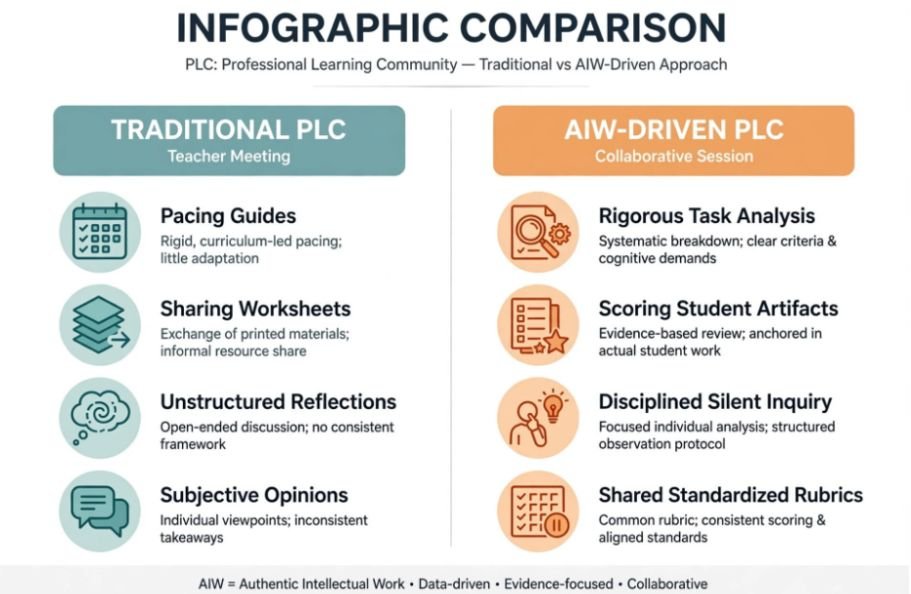
Traditional PLC vs. AIW-Driven PLC
| Traditional Teacher Meeting | AIW Collaborative Session |
| Pacing guides and test schedules | Rigorous task analysis |
| Sharing worksheets & activities | Scoring student artifacts |
| Unstructured lesson reflections | Disciplined, silent inquiry |
| Subjective opinions on pedagogy | Shared, standardized rubrics |
The Three Pillars of Authentic Intellectual Work
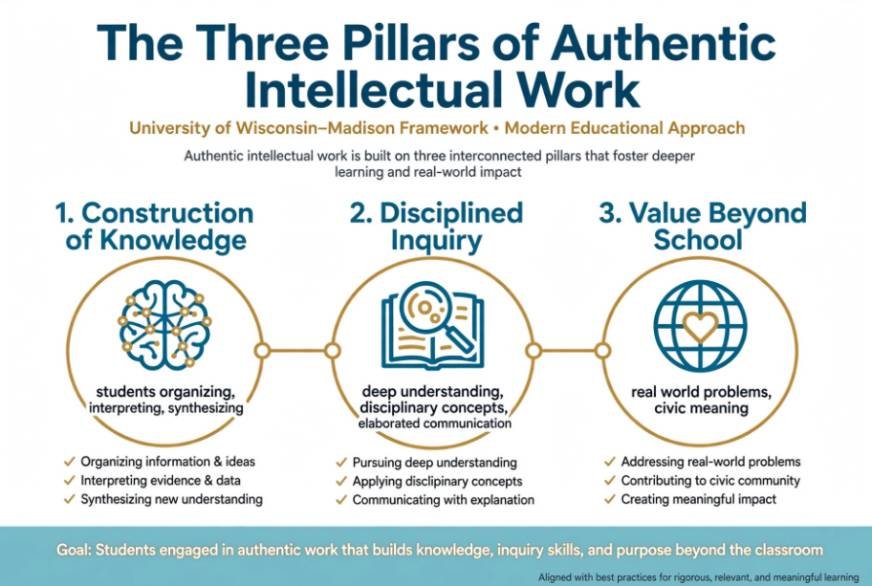
To ground our professional learning, we evaluate all curriculum and student output against three core criteria established in the Framework for Authentic Intellectual Work:
- Construction of Knowledge: Students organize, interpret, synthesize, and evaluate information rather than merely retrieving stored facts. Understanding the distinction between construction of knowledge vs. reproduction in authentic learning helps teachers identify whether classroom assignments encourage deeper thinking or simply require students to repeat information.
- Disciplined Inquiry: Students draw on established disciplinary concepts, develop deep understanding, and communicate complex ideas through elaborated written or verbal expression.
- Value Beyond School: The learning task addresses a problem, issue, or personal experience that carries real meaning outside the classroom walls.
Targeted professional development for construction of knowledge trains teachers to spot where tasks fall short on these pillars before teaching the lesson.
Inside an AIW Workshop: What Disciplined Team Learning Looks Like
Official programs offered through the AIW Institute steer school teams through structured mini-courses, scoring refreshers, and multi-year coaching partnerships. A productive workshop is not a lecture; it is an active laboratory.
Standardizing the Scoring Rubric Across Subjects
During cohort training, our interdisciplinary teams—combining math, humanities, and science teachers—score identical lesson plans using 1-to-4 or 1-to-5 scaled rubrics. The magic happens during the scoring calibration. When three teachers give an assignment a “4” and two give it a “2,” the team must defend their ratings with textual evidence from the prompt.
These calibration discussions clarify what high-order thinking actually looks like in practice. Cross-departmental alignment deepens quickly when a physics teacher and a history teacher realize they demand the same evidence-based reasoning from their students.
Analyzing Student Work Without Teacher Defensiveness
AIW professional development uses a strict meeting protocol to safeguard presenting teachers:
- Contextual Framing (3 minutes): The presenting teacher shares the target standard and learning goals without making excuses or defending the material.
- Silent Examination (10 minutes): Colleagues examine the prompt and low-, medium-, and high-performing student work samples in complete silence.
- Peer Deliberation (15 minutes): The team discusses where students constructed knowledge and where they defaulted to rote repetition. During this time, the presenting teacher remains silent, taking notes.
- Collaborative Revision (15 minutes): The presenting educator rejoins the conversation to refine the prompt, adjust expectations, and design stronger instructional scaffolding.
Removing spontaneous defense mechanisms allows educators to view student work with objective clarity.
Real Classroom Transformation: Our Shift From Compliance to Inquiry
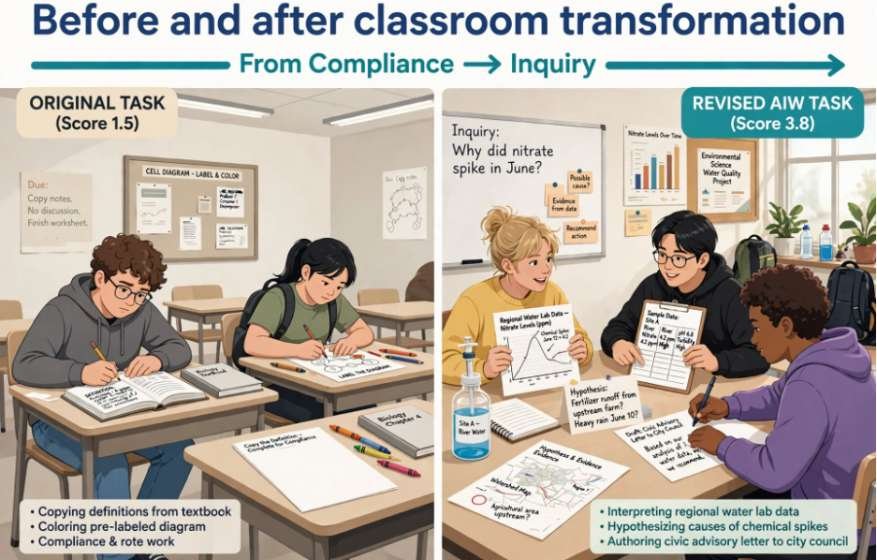
The practical value of this collaborative framework became clear to our team during an 8th-grade environmental science unit.
Before our AIW training, the culminating assessment asked students to define five vocabulary terms (e.g., runoff, eutrophication, watershed) and complete a pre-labeled diagram showing agricultural pollution. When we scored that original task against the AIW rubric, it earned a 1.5 out of 4. The assignment required zero knowledge construction; students simply located definitions in their textbooks and copied them down.
Our team spent 40 minutes redesigning the assignment during an AIW work session. The revised task presented students with real municipal water-quality testing reports from our local river basin across three separate calendar quarters. Students had to identify anomalies, form a hypothesis explaining the chemical spikes, and draft a formal advisory letter to the city council recommending specific mitigation steps.
ORIGINAL TASK (Score: 1.5) REVISED AIW TASK (Score: 3.8)
+—————————————+ +—————————————+
| • Define 5 water terms from textbook | | • Interpret regional water lab data |
| • Color and label existing diagram |–>| • Hypothesize causes of chemical spikes|
| • Fill in blanks on multiple-choice | | • Author actionable civic advisory |
+—————————————+ +—————————————+
The resulting student work showed an immediate jump in disciplined inquiry. Students were not just completing a worksheet; they were evaluating competing evidence and producing elaborated arguments.
Common Obstacles During Implementation and Practical Fixes
Adopting AIW is intellectually demanding, and schools often encounter hurdles early in the process:
- Initiative Fatigue: Teachers often view AIW as “one more thing” piled onto existing duties. The solution is using AIW as an instructional filter rather than an additional curriculum. It replaces fragmented meeting agendas with a single, clear protocol.
- Rubric Drift: Without periodic refresher sessions, scoring standards loosen over time, and teams drift back toward grade inflation. Scheduling semester calibration checks prevents this drift.
- Time Scarcity: A rigorous review requires at least 45 to 60 uninterrupted minutes. Protecting this planning block requires firm administrative commitment.
Stop Trading Worksheets: Take Your Team Further
If your weekly grade-level meetings feel like administrative checklist sessions, change the operating system of your collaboration. Bringing aiw professional development workshops for teacher collaboration into your building gives teachers an objective, evidence-based roadmap.
Start small: select one upcoming unit assessment, run it through the three AIW criteria with a trusted colleague, and notice where simple task tweaks unlock genuine, authentic thinking.
Frequently Asked Questions
1. What is the primary purpose of an AIW workshop?
AIW workshops train teachers to evaluate and elevate classroom assignments, instruction, and student work using shared, research-grounded rubrics.
2. How do AIW workshops improve weekly PLC meetings?
They provide structured review protocols that eliminate subjective opinions and keep teacher dialogue focused on evidence of student thinking.
3. Can the AIW framework be applied across all grade levels?
Yes, the core criteria apply across elementary, middle, and high school classrooms in all academic subjects.
4. How does AIW differ from traditional professional development?
Instead of presenting passive instructional theories, AIW workshops train educators to collaboratively analyze and redesign their own curriculum materials.