Authentic Assessment Tasks Promoting Student Construction of Knowledge
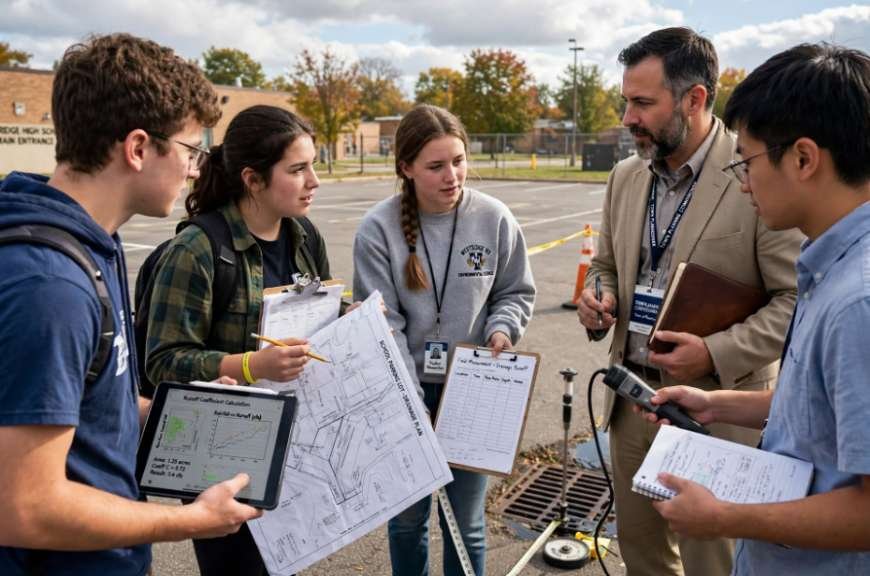
When I gave my seniors a standard twenty-question multiple-choice exam on municipal environmental policy, seventy-two percent scored above an eighty. Two weeks later, I asked those same students to calculate the drainage runoff coefficient of our school parking lot, present their findings to our town planning commissioner, and defend their mitigation ideas.
Most of them froze.
They could recite the definition of impervious surface cover, yet they could not map out an actionable design because standard tests measure passive information storage rather than active application. Designing and executing authentic assessment tasks promoting student construction of knowledge completely rebuilt my approach to instructional design. When learners confront ambiguous, high-stakes scenarios instead of sanitized question stems, they must construct original frameworks, reconcile competing priorities, and turn abstract information into functional intellect.
The Fundamental Shift from Retrieval to Real-World Application
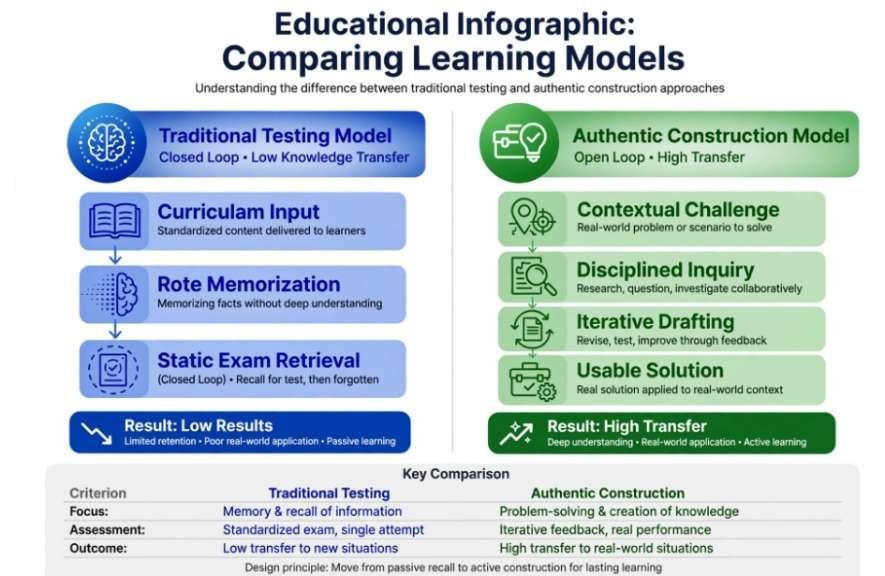
Traditional classroom assessments operate as closed audits of short-term memory. A student memorizes formulas, reproduces them on an exam page, and promptly purges that information within forty-eight hours. Authentic tasks reverse this trajectory by placing the learner in a context-rich professional or civic role.
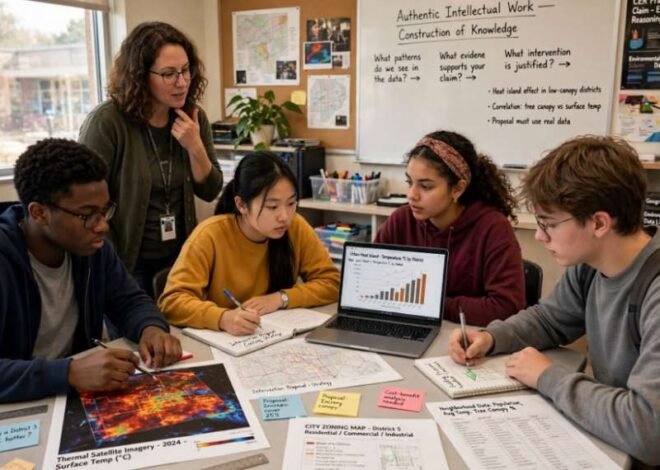
According to research documented by the Center for Authentic Intellectual Work, rigorous student engagement demands disciplined inquiry directed toward problems holding value beyond classroom walls.
Grounding curricular units in authentic intellectual work standards transforms students from passive observers into investigators who extract meaning from raw evidence.
Traditional Testing Model:
Curriculum Input ──> Rote Memorization ──> Static Exam Retrieval (Closed Loop)
Authentic Construction Model:
Contextual Challenge ──> Disciplined Inquiry ──> Iterative Drafting ──> Usable Solution
Dissecting the Architecture of Authentic Tasks
An authentic task must mirror the messy realities of external professions. Standard textbook exercises provide every variable up front and guarantee a single correct answer. Real tasks require students to determine which variables actually matter and discard the rest.
In his foundational writing for Edutopia on authentic assessment, Grant Wiggins emphasized that genuine assessment replicates how scientists, policy makers, or artists perform in their fields. The task forces students to use content as a tactical resource rather than treat it as the final objective.
How Authentic Tasks Drive Active Knowledge Construction
Students construct lasting knowledge only when their existing cognitive models face friction. If an assignment provides step-by-step assembly instructions, the student follows an algorithm without internalizing the underlying mechanics. When you strip away prescriptive formulas, you force learners to deploy specific thinking strategies for construction of knowledge like dialectical reasoning and causal modeling.
To help students develop these abilities systematically, educators can explore how to teach students construction of knowledge in secondary school, using structured inquiry, critical questioning, and scaffolded learning experiences to move students beyond passive information retrieval.
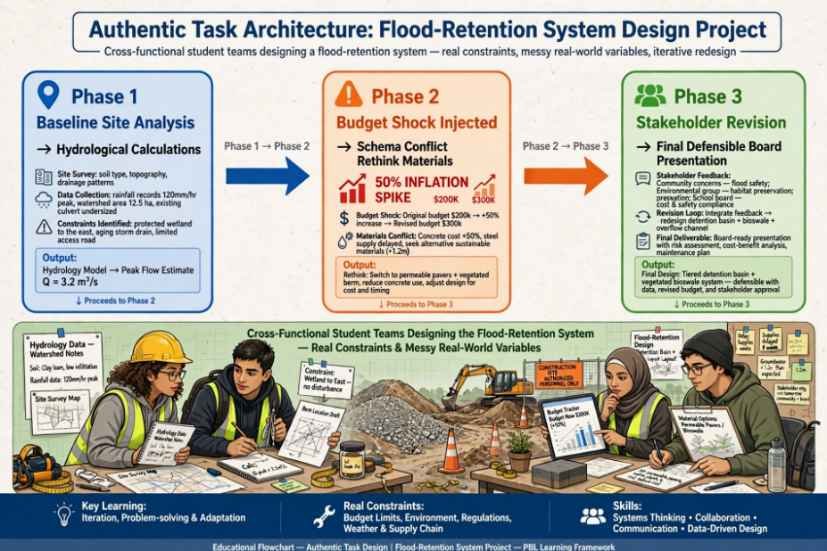
During a recent regional infrastructure unit, I divided thirty-two students into cross-functional teams tasked with designing a flood-retention system on a fixed municipal budget. I added sudden real-world constraints across three weeks: an unexpected fifty percent inflation spike on concrete, a contested local environmental zoning ordinance, and an unmapped underground utility line.
Phase 1: Baseline Site Analysis ──> Hydrological Calculations
│
Phase 2: Budget Shock Injected ──> Schema Conflict (Rethink Materials)
│
Phase 3: Stakeholder Revision ──> Final Defensible Board Presentation
The outcome startled me. The students were not simply looking up hydrological data. They were evaluating trade-offs, calculating lifecycle costs, and adjusting their mental models to balance soil absorption against civil liability. Longitudinal educational findings indexed by the ERIC Database verify that this form of situated learning yields significantly higher transfer rates across dissimilar cognitive problems.
Structuring Unscripted Decision Points in the Classroom
To make knowledge construction inevitable, your task must include intentional decision forks:
- Incomplete Data Sets: Force students to find credible local sources or perform raw physical measurements rather than providing clean, sanitized numbers.
- Conflicting Stakeholder Objectives: Require designs to satisfy two opposing groups, such as a factory management council and an adjacent residential neighborhood.
- Resource Bottlenecks: Restrict capital, physical supplies, or available timelines to mirror actual workplace limitations.
A Field-Tested Implementation Blueprint
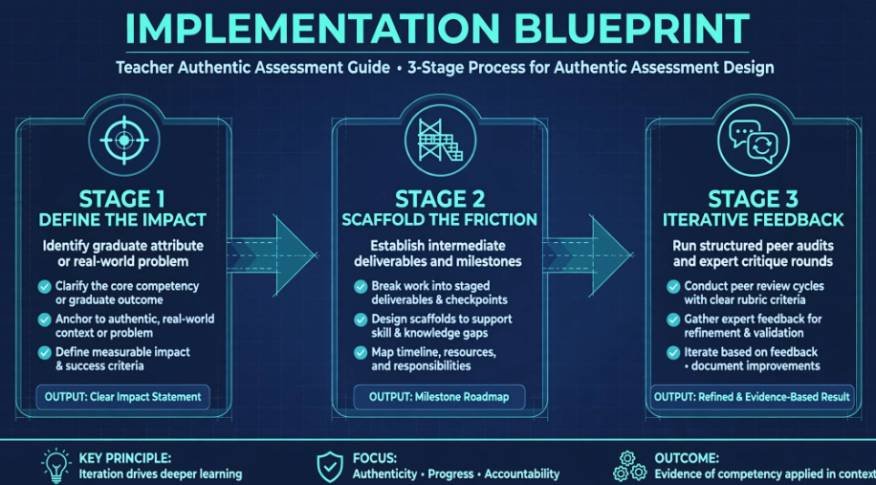
Transforming an existing curriculum does not require tossing out your entire syllabus. You can scaffold open-ended inquiry systematically through backward design.
┌────────────────────────────────────────────────────────┐
│ STAGE 1: DEFINE THE IMPACT │
│ Identify the graduate attribute or real-world problem. │
└──────────────────────────┬─────────────────────────────┘
│
┌──────────────────────────▼─────────────────────────────┐
│ STAGE 2: SCAFFOLD THE FRICTION │
│ Establish intermediate deliverables and milestones. │
└──────────────────────────┬─────────────────────────────┘
│
┌──────────────────────────▼─────────────────────────────┐
│ STAGE 3: ITERATIVE FEEDBACK │
│ Run structured peer audits and expert critique rounds. │
└────────────────────────────────────────────────────────┘
Phase 1: Contextual Anchoring and Backward Mapping
Start with the ultimate professional artifact you want students to generate. If the unit covers epidemiological dynamics, do not write a forty-question test on viral replication. Instead, ask your students to draft an operational disease-containment brief for a county public health board during an active respiratory outbreak. Work backward from that artifact to establish the precise biochemical concepts, statistical skills, and communication techniques they will need to assemble it.
Phase 2: Formative Milestones and Iterative Revision
Never assign an authentic task as a single-deadline project. Long-term construction needs intermediate checkpoints with iterative loops:
- The Abstract and Problem Scope: Students define the problem, identify necessary variables, and isolate missing datasets.
- The Prototype or Field Brief: Teams submit rough methodology sketches and receive diagnostic feedback from peers.
- The Defense and Delivery: Students present their finished product before a panel of peers or external practitioners who pose unscripted questions.
Breaking the task into manageable phases ensures learners revise their conceptual understanding before reaching their final submission.
Transparent Evaluation Without Smothering Student Agency
Traditional rubrics often reward compliance instead of intellectual rigor. If a grading sheet simply checks off font sizes, slide counts, and required citations, students focus on formatting rather than problem-solving. Authentic rubrics must evaluate critical thinking, problem-framing, and justification.
| Evaluation Criterion | Low Performance Focus | Authentic Construction Focus |
| Problem Definition | Restates prompt instructions verbatim. | Identifies systemic constraints and conflicting community needs. |
| Evidence Integration | Summarizes secondary citations without analysis. | Synthesizes field data to defend a specific intervention. |
| Viability of Solution | Offers idealized solutions detached from cost or law. | Balances real-world financial, logistical, and legal trade-offs. |
| Metacognitive Revision | Replaces misspelled words between drafts. | Substantively refactors methodology based on diagnostic critique. |
Slay the Rote Testing Monster: Your Next Move
Standardized multiple-choice tests are comfortable because they grade quickly. But they fail to show whether a student can actually put knowledge to work.
Pick one upcoming unit this semester. Take your existing final exam, isolate the single most important concept on that page, and turn it into an authentic task. Put your students in a room with an ambiguous problem, genuine constraints, and an authentic audience. Step back, let them wrestle with the missing pieces, and watch real understanding take root.
Frequently Asked Questions
1. What are the main characteristics of authentic assessment?
Authentic assessment requires students to apply disciplinary knowledge to ill-structured, real-world problems for authentic audiences.
2. How does authentic assessment promote student construction of knowledge?
It forces students to evaluate conflicting information, solve unexpected problems, and build original solutions rather than simply retrieving memorized facts.
3. Can authentic assessment replace standardized testing in classrooms?
Yes, authentic tasks can fully replace traditional summative exams by evaluating student application, synthesis, and deep content mastery throughout a course.
4. How do educators grade authentic performance tasks fairly?
Educators use transparent, criterion-referenced analytic rubrics that assess problem formulation, analytical depth, and practical viability rather than rote compliance.