
Instructional Coaching to Build Knowledge Construction in the Classroom
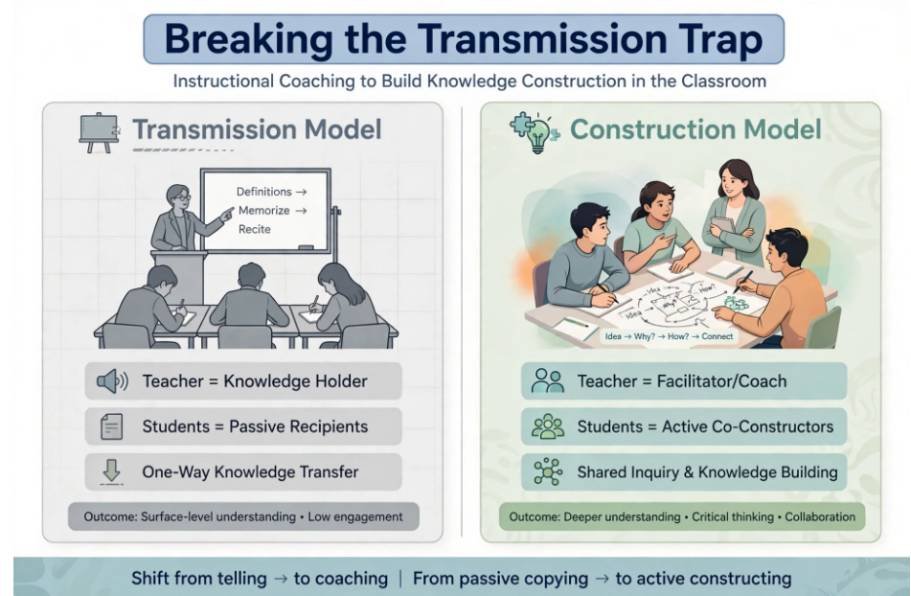
When I walk into a classroom where students passively copy definitions off a whiteboard, I do not see a teacher struggling with classroom management. I see a dedicated educator trapped inside the transmission model of teaching. Memorizing isolated facts does not generate deep retention, schema expansion, or critical problem-solving skills.
To shift this dynamic, effective instructional coaching to build knowledge construction in the classroom requires a deliberate, non-evaluative partnership that moves teachers away from lecturing and toward cognitive facilitation.
True learning occurs when students connect raw information to existing cognitive schemas. For instructional coaches, our mandate is clear: we must change the classroom architecture so students perform the heavy mental lifting.
Breaking the Transmission Trap: My Realization in Room 204
Six years ago, I partnered with Marcus, an eighth-grade science teacher whose classroom ran like clockwork. His slide decks were polished, his pacing was immaculate, and his students were silent. Yet, his end-of-unit assessments showed severe gaps whenever questions required synthesizing multiple variables. Marcus did all the thinking for forty-five minutes while his students observed him work.
This challenge reflects the difference between construction of knowledge vs. reproduction in authentic learning, where students actively develop understanding, and traditional approaches that prioritize memorizing and reproducing information.
To rewire this dynamic, we needed more than superficial tips on classroom arrangement. We turned to targeted aiw professional development workshops to ground our practice in Authentic Intellectual Work. Marcus did not need to talk louder or plan tighter transitions. He needed to design cognitive spaces where students wrestled with ambiguous evidence, reconciled conflicting patterns, and generated their own conceptual models.
According to research synthesized by the Institute of Education Sciences, active learning environments where students articulate conceptual connections yield significantly higher long-term retention than direct lecture formats. Knowledge is not transmitted across a room like a radio signal; learners construct it through social discourse, dissonance, and personal synthesis.
The Plan-Teach-Debrief Cycle That Drives Cognitive Schema
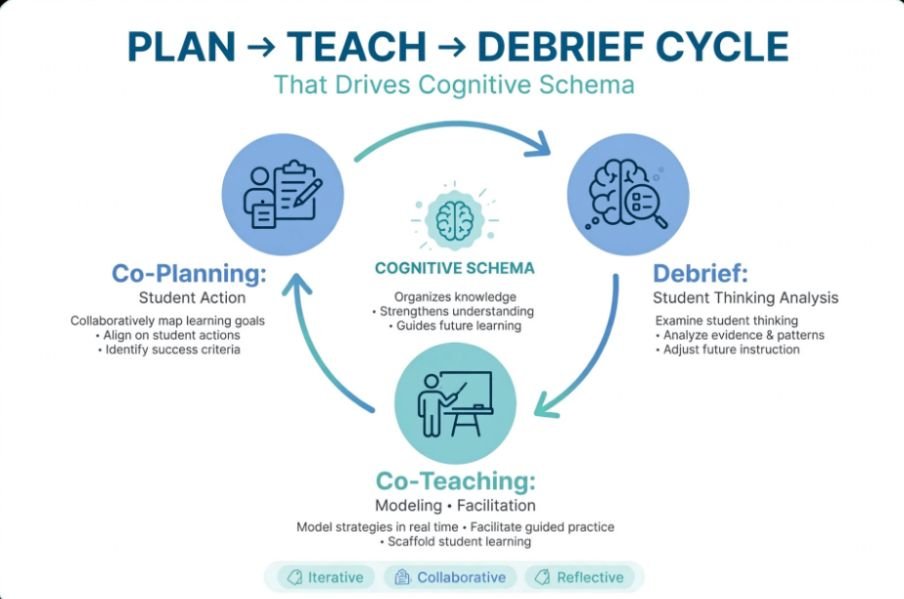
Constructivist classrooms feel unpredictable to teachers accustomed to strict lesson scripts. When students argue interpretations or design their own scientific investigations, lesson plans rarely unfold in straight lines. Coaches provide psychological safety by establishing a structured, job-embedded Plan-Teach-Debrief cycle.
[ Co-Planning: Student Action ] ──> [ Co-Teaching: Modeling Facilitation ] ──> [ Debrief: Student Thinking Analysis ]
Co-Planning Around Student Misconceptions Rather Than Teacher Delivery
Traditional co-planning sessions fixate on what the teacher will say, which slides they will project, and what time to start independent practice. We reverse that lens.
During our planning periods, we outline what students will write, debate, sketch, and critique. We map the conceptual terrain before class starts:
- What prior misconceptions will students bring into this topic?
- What specific scaffolding prompt will unlock productive struggle if a small group stalls?
- What explicit evidence must students produce to prove they built a new schema?
Focusing on student actions allows teachers to prepare for dynamic exploration rather than rigid recitation.
Modeling Cognitive Prompts During Live Co-Teaching
Teachers cannot always visualize what constructivist facilitation sounds like in real time. Stepping directly into the room alongside a colleague bridges the gap between theory and execution.
I do not step in to rescue a lesson or show off. I enter the room to model cognitive nudges. While Marcus facilitates a laboratory station, I circulate among student pairs, asking questions like: “Why does this data point contradict what you found in trial one?” or “Who at your table holds an opposing view, and what evidence supports them?”
Observing a coach validate hesitation and lean into student ambiguity demonstrates that silence often signals cognitive processing, not confusion.
Non-Evaluative Debriefs Anchored in Student Artefacts
A constructivist coaching debrief never focuses on teacher charisma, voice projection, or compliance. Instead, we analyze student work samples, transcript snippets, and sticky-note exit tickets laid out between us.
We evaluate the depth of student thinking against cognitive rubrics. If student work shows uniform, identical answers, the assignment limited knowledge construction. If their written explanations show diverse, reasoned pathways to a solution, the lesson succeeded. Removing personal judgment keeps the debrief objective, scientific, and collaborative.
High-Impact Coaching Moves for Meaningful Student Dialogue
To scaffold constructivist teaching reliably, instructional coaches must focus on three core instructional levers: questioning profiles, task depth, and discourse routines.
Auditing Teacher Questioning Profiles: Shifting from Recall to Sense-Making
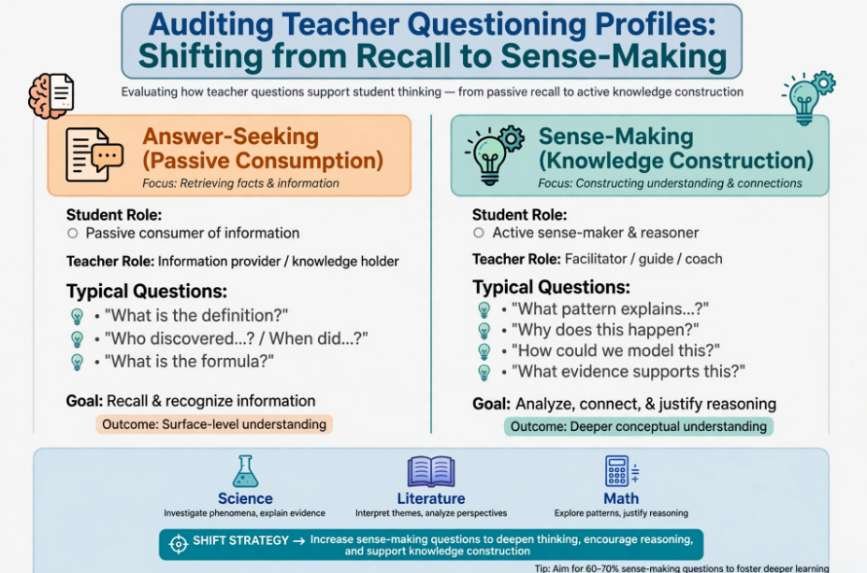
A teacher’s questioning profile determines the intellectual climate of the room. Passive classrooms drown in answer-seeking questions that demand immediate, one-word factual recall. Constructivist classrooms run on sense-making inquiries that force students to synthesize ideas.
| Question Dimension | Answer-Seeking (Passive Consumption) | Sense-Making (Knowledge Construction) |
| Science Analysis | “What is the biological definition of osmosis?” | “Based on this cell mass data, what pattern explains how water moved across the membrane?” |
| Literary Interpretation | “Who is the primary antagonist in chapter four?” | “How does the author’s syntax shift between these paragraphs to establish a sense of unease?” |
| Mathematical Reasoning | “What is the final value for problem number six?” | “Marcus got 42 using an area model, while Sarah got 42 using decomposition. How do both paths validate the theorem?” |
During classroom observations, I log a running tally of factual recall prompts versus analytical prompts. In our debrief, we review this ratio together. Seeing that 80% of classroom questions were closed-ended provides an objective baseline for teachers seeking to elevate cognitive demand.
Designing Open-Ended Tasks via Webb’s Depth of Knowledge
Students cannot build authentic knowledge when assignments only ask them to retrieve and record information. We use Webb’s Depth of Knowledge (DOK) framework to audit classroom assignments, stripping away superficial fill-in-the-blank worksheets in favor of DOK Level 3 (Strategic Thinking) and Level 4 (Extended Thinking) experiences.
For comprehensive curriculum overhauls, schools rely on structured professional development for construction of knowledge to build systematic task-design frameworks across departments.
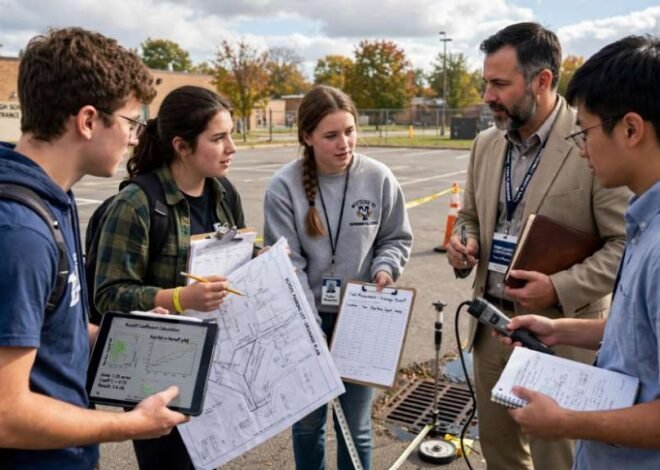
Instead of assigning ten isolated textbook problems, we structure lessons around authentic, open-ended challenges. We ask students to calculate municipal flood risks based on local topographic data or evaluate competing historical accounts of an industrial strike. Deep conceptual synthesis requires cognitive space for investigation, trial, and revision.
Structuring Accountable Talk and Controversy Protocols
Authentic knowledge construction is an inherently social process. As the researchers at Harvard’s Project Zero demonstrate through their Visible Thinking routines, making internal reasoning transparent to peers accelerates conceptual synthesis.
We implement structured dialogue frameworks so students bypass the teacher and interact directly:
- Sentence Stems for Evidence-Based Reasoning: Provide desk references with prompts like “My conclusion builds on Maya’s point because…” or “What counter-evidence explains that anomaly?”
- Structured Controversy Protocols: Split student groups into opposing analytical perspectives. Each side marshals textual evidence, presents their claims, and is then required to abandon their defensive postures to co-write a balanced compromise.
Diagnostic Look-Fors: What Knowledge Construction Looks Like on the Ground
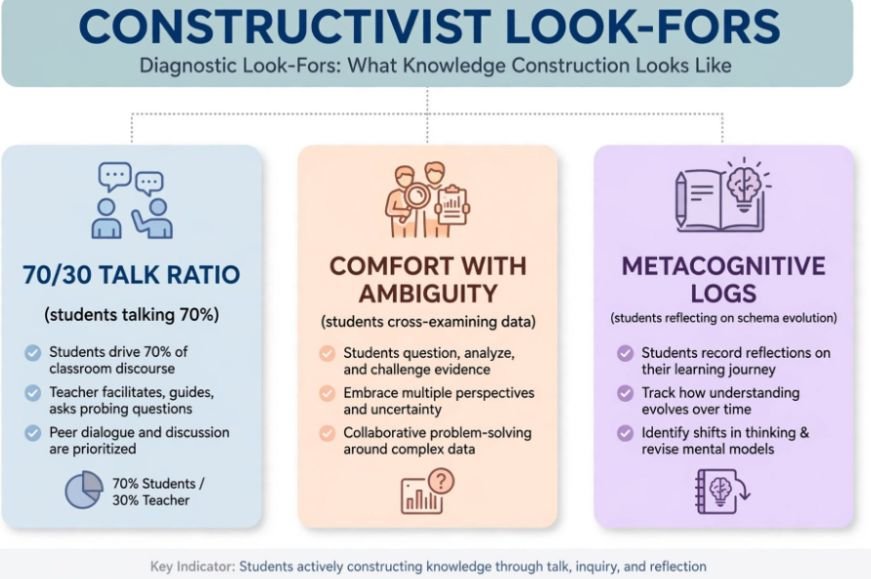
When district leaders or instructional coaches evaluate the real-world impact of these coaching interventions, they must watch student behaviors, not teacher activity. Look for these four field indicators:
┌───────────────────────────────────────────────┐
│ CONSTRUCTIVIST LOOK-FORS │
└──────────────────────┬────────────────────────┘
│
┌───────────────────────────────┼──────────────────────────────┐
▼ ▼ ▼
[ 70/30 Talk Ratio ] [ Comfort With Ambiguity ] [ Metacognitive Logs ]
Students direct discourse; Pupils cross-examine data Exit tickets chart how
peer-to-peer questioning and anchor charts before conceptual schemas
supersedes teacher talk. requesting help. evolved during class.
- The 70/30 Talk Distribution: The balance of airtime flips. Students speak for at least 70% of collaborative work blocks, challenging each other’s assertions rather than channeling every thought through the teacher.
- Productive Persistence: When students reach a conceptual hurdle, they do not immediately freeze. They analyze reference rubrics, cross-examine team members, and test working hypotheses before asking for help.
- Externalized Thinking Artefacts: Classroom walls feature messy whiteboards, concept maps, and evolving schema diagrams rather than static, store-bought inspirational posters.
- Metacognitive Reflection: Student exit reflections demonstrate explicit intellectual shifts. A student writes: “At 9:15, I assumed heavier objects fall faster in a vacuum; by 9:45, our acceleration graphs proved air resistance was the true confounding variable.”
Ditch the Script, Map the Thinking
Transforming a school from a culture of lecture-driven compliance into a vibrant hub of student-led discovery cannot happen through administrative directives. It happens one coaching cycle at a time, inside real classrooms, over messy student work samples.
If you want your teachers to foster genuine intellectual autonomy in their students, model that exact autonomy in your coaching. Stop assessing teacher performance like an inspector with a checklist. Sit alongside your colleagues, scrutinize student discourse patterns, and co-design lessons where students wrestle with authentic questions. The deepest learning never happens when teachers have all the right answers; it happens when students are given the tools, evidence, and space to discover those answers for themselves.
Frequently Asked Questions
1. What is knowledge construction in instructional coaching?
It is a coaching approach centered on helping teachers design lessons where students actively build, critique, and synthesize conceptual schemas rather than passively memorizing transmitted information.
2. How do coaches help teachers let go of direct lecturing?
Coaches provide psychological safety through structured co-planning, live modeling of inquiry facilitation, and non-evaluative debriefs focused entirely on student thinking data.
3. How do you measure student talk versus teacher talk objectively?
Observers use two-column interval tally sheets to record active speakers every sixty seconds, calculating the percentage of student-to-student discourse versus teacher direct delivery.
4. What is the fastest coaching move to increase classroom cognitive demand?
Help teachers replace factual recall prompts with open-ended comparative questions that require students to defend their claims using observable data and evidence.