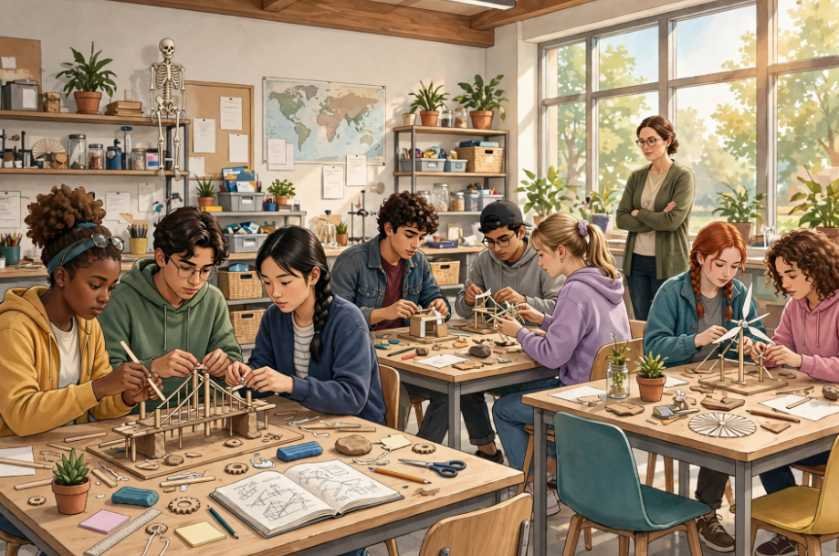
How to Teach Students Construction of Knowledge in Secondary School
Secondary students forget 70% of a lecture within twenty-four hours because hearing an explanation does not equal understanding it. When I stepped into my high school classroom a decade ago, my meticulously scripted explanations produced blank stares on exams.
Real learning took off only when I stopped acting as an information dispenser and structured my room so teens had to assemble their own understanding. Knowing how to teach students construction of knowledge in secondary school turns your classroom into an active laboratory of ideas where students build durable cognitive schemas that stick.
Constructivist Knowledge Loop
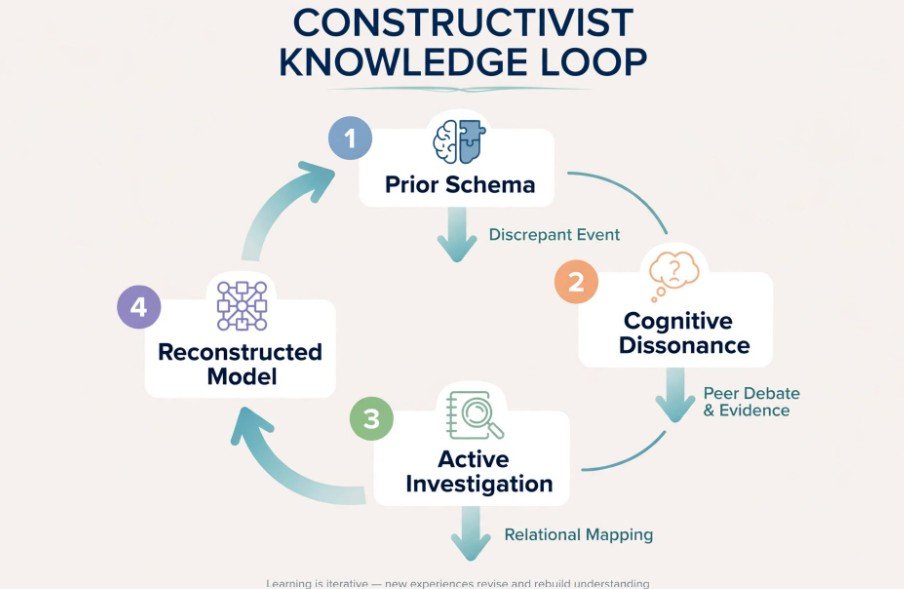
[ 1. Prior Schema ]
│
▼ (Discrepant Event)
[ 2. Cognitive Dissonance ]
│
▼ (Peer Debate & Evidence)
[ 3. Active Investigation ]
│
▼ (Relational Mapping)
[ 4. Reconstructed Model ]
Rethinking Secondary Instruction: Why Knowledge Isn’t Delivered
Adolescents do not absorb knowledge; they manufacture it.
According to foundational cognitive research synthesized by the Vanderbilt University Center for Teaching, students construct new concepts upon the foundations of their prior experiences, existing beliefs, and misconceptions. If an instructor attempts to drop abstract conclusions directly into a student’s brain, the brain defaults to rote learning. That memorized data vanishes the second the test ends.
From Passive Listeners to Knowledge Architects
Middle and high schoolers undergo massive neurological remodeling. Their prefrontal cortex is developing abstract reasoning skills, yet they crave autonomy and peer validation. Standard teacher-led lectures fight this biological reality. Constructivist classrooms harness it.
By transforming your role into a facilitator, you create conditions where students reconcile new observations with prior assumptions.
Instructional coaches can support this transition through instructional coaching to build knowledge construction in the classroom, helping teachers design inquiry-driven lessons that encourage students to investigate, collaborate, and develop their own understanding.
Understanding Adolescent Neurological Development and Implications for Health and Well-Being helps educators recognize how developmental changes influence students’ learning preferences, reasoning abilities, and need for autonomy.
Breaking the Illusion of Explanatory Depth
Secondary learners often suffer from an illusion of explanatory depth. They nod along with a clean slide presentation, genuinely convinced they master the material. Five minutes later, when challenged to explain the underlying mechanics, their grasp collapses. Knowledge construction requires stripping away that false sense of mastery early, using purposeful confusion to reveal conceptual gaps.
Rather than rewarding students for simply recalling information, educators should emphasize construction of knowledge vs. reproduction in authentic learning, where learners develop deeper understanding by connecting ideas, evaluating evidence, and applying concepts independently.
Phase 1: Activate Schemas with Intentional Cognitive Dissonance
You cannot construct a sturdy building on an untested foundation. Before presenting new academic content, you must unearth what students already believe about the topic.
Anticipation Guides that Spark Immediate Debate
I kick off new units with provocative, binary statements rather than dry vocabulary lists. In biology or earth science, I project statements such as:
- Trees gain the vast majority of their mass directly from rich soil.
- Cold air forces its way through the cracks of a window frame.
Students vote instantly using index cards. No middle ground is allowed. The resulting arguments electrify the room. When students find themselves publicly divided, their brains enter a state of constructive dissonance. They suddenly have a personal, competitive stake in discovering the empirical truth.
Tactile Discrepant Events
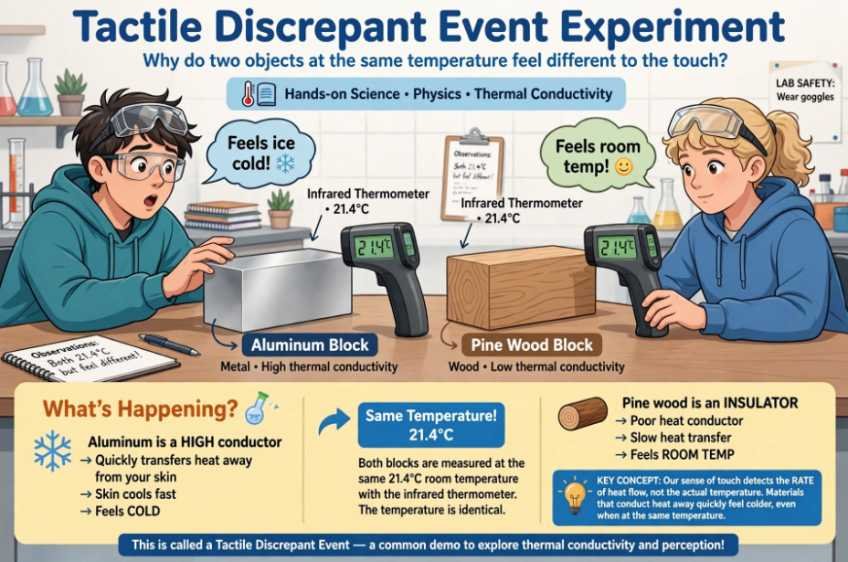
Nothing shatters a flawed mental model faster than tangible proof. Hand high schoolers an aluminum block and an untreated wooden block that sat side by side on your desk overnight. Ask them which object is colder. Nearly all will declare the metal block colder.
+——————–+———————+———————+
| Material Tested | Tactile Prediction | Surface Temp (IR) |
+——————–+———————+———————+
| Aluminum Block | “Feels Ice Cold” | 21.4°C |
| Pine Wood Block | “Feels Room Temp” | 21.4°C |
+——————–+———————+———————+
Aim an infrared thermometer at both blocks. The digital readout displays identical temperatures. That momentary disbelief creates an immediate, irresistible cognitive opening. The class is suddenly desperate to reconcile what their fingers felt with what the instrument measures.
Phase 2: Scaffold Active Investigation Without Micromanaging
Constructivism is never chaotic, unguided discovery. Without intentional guardrails, adolescents flounder, experience cognitive overload, and solidify incorrect ideas. Educational frameworks highlighted by Edutopia demonstrate that disciplined scaffolding keeps inquiry productive and grounded.
Teachers can strengthen these practices through AIW professional development workshops for teacher collaboration, where collaborative learning and shared instructional strategies help educators design more engaging, inquiry-driven classroom experiences.
Multimodal Stations Over Textbook Worksheets
Replace static textbook pages with three to four interactive evidence stations. Each station should provide a distinct entry point into the central mystery:
- A Physical Micro-Lab: A short, three-minute empirical test, such as monitoring ice melting speeds on disparate materials.
- A Raw Dataset or Historical Document: Primary text extracts, meteorological tables, or infrared photography without commentary.
- An Interactive Digital Simulation: Particle simulators or economic market adjusters where learners modify one variable and watch direct downstream effects.
Students rotate in trios with an investigation log. Their task is never to write a rote summary. Instead, they record raw observations that support or refute their initial anticipation vote.
Discourse Protocols that Demand Peer Defense
Social discourse drives conceptual change. When teenagers argue productively with classmates, they must clarify their thinking and patch logical holes. I rely heavily on visible thinking routines curated by Harvard Graduate School of Education (Project Zero).
Put students in reciprocal pairs with strict sentence starters:
- “The data at Station 2 challenges your claim because…”
- “What mechanism explains why both readings matched?”
This dialogue forces students to defend their inferences using empirical evidence instead of gut feelings. They construct collective understanding through disciplined debate.
Phase 3: Cement Understanding Through Student-Built Synthesis Models
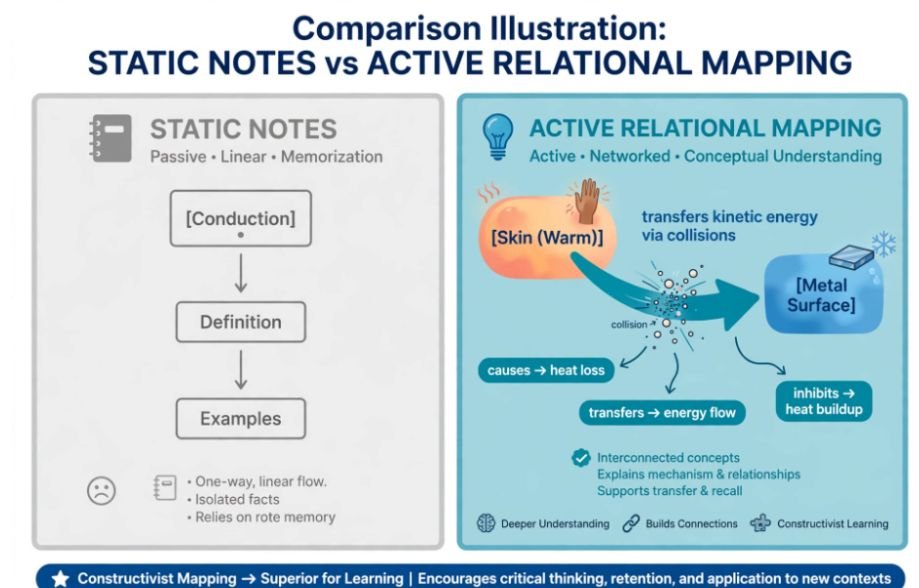
Knowledge construction remains unfinished until students organize, translate, and model their newly acquired principles.
STATIC NOTES vs. ACTIVE RELATIONAL MAPPING
Static Copy: Active Constructivist Map:
[ Conduction ] [ Skin (Warm) ]
↓ │
(Definition) transfers kinetic energy via collisions
↓ ▼
[ Examples ] [ Metal Surface ]
Relational Concept Mapping
Ban generic bullet-point outlines during the synthesis phase. Require relational concept maps instead. In these visual diagrams, every connecting arrow must contain an active linking verb, such as causes, inhibits, accelerates, or destabilizes. A line without an explanatory verb receives zero credit.
This constraint forces the adolescent brain to map explicit causation and systems-level interaction rather than resting on superficial associations. Pair this with ongoing formative assessment strategies to catch subtle logical breakdowns before they harden into habits.
The Microscopic Exit Model
Conclude the instructional loop with a grounded transfer prompt. For our thermal energy investigation, ask: “Draw a particle-level diagram explaining why birds fluff up their feathers during sub-zero mornings.”
If students have constructed genuine knowledge, they will not regurgitate canned definitions. They will sketch trapped air pockets, diagram sparse particle collisions, and describe minimized kinetic energy dissipation. They have successfully built the concept themselves.
Frequently Asked Questions
1. What is the core idea of constructivist teaching in high school?
Students construct personal conceptual models by actively investigating data rather than receiving facts through lectures.
2. How do I prevent misconceptions from taking root during open inquiry?
Anchor each station in hard empirical constraints and conclude every lesson with a teacher-facilitated consensus discussion.
3. Does constructivist pedagogy meet state and national secondary standards?
Yes, it directly addresses critical-thinking and reasoning benchmarks emphasized by organizations like the National Science Teaching Association (NSTA).
4. How can I apply constructivism within tight 45-minute class periods?
Split your period into three tightly timed blocks: a 10-minute hook, a 20-minute investigation, and a 15-minute modeling session.
Ditch the Script and Hand Over the Reins
Stepping back from the front of the classroom feels vulnerable. It demands that you trade comfortable scripts for the dynamic unpredictability of authentic student inquiry.
Yet watching a teenager’s eyes light up when their own deduction cracks open a complex principle is the greatest reward in secondary education. Pick one lesson scheduled for next week. Strip out your explanatory slides, build a three-question anticipation guide, set out raw evidence, and let your students take the wheel.