Rubrics for Evaluating Student Construction of Knowledge in Student Work
A well-formatted essay complete with clean citations and fluent summaries can easily hide a lack of genuine understanding. Traditional assessment grids reward mechanical compliance rather than intellectual discovery. Deploying rubrics for evaluating student construction of knowledge in student work is the only reliable way to separate authentic cognitive breakthroughs from superficial mimicry.
When students simply regurgitate isolated textbook claims, learning remains shallow. Knowledge construction requires learners to connect raw information to existing cognitive schemas, critique opposing evidence, and adapt concepts to unfamiliar domains.
Grading this active transformation requires an analytic structure that ignores surface gloss and evaluates intellectual processing directly.
The Fundamental Flaw with Standard Scoring Grids
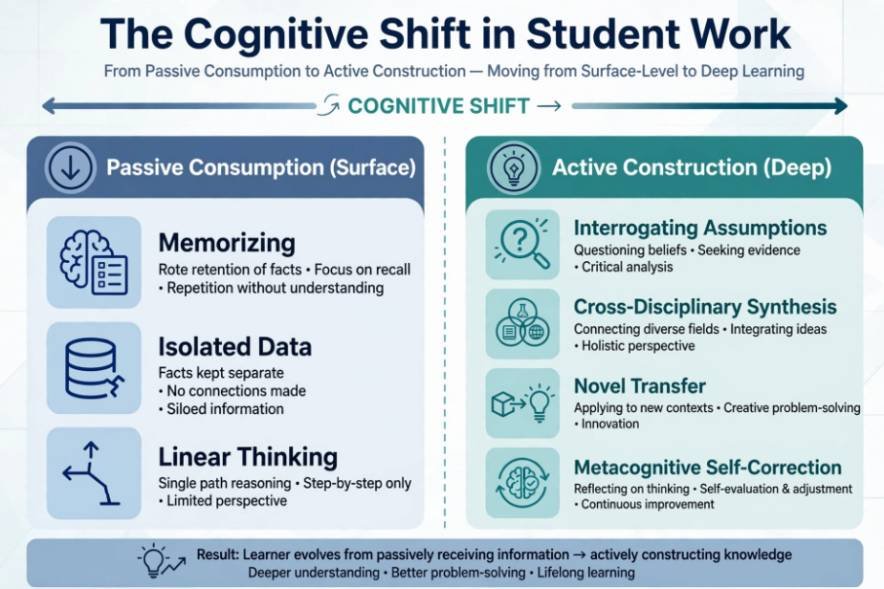
Standard rubrics focus heavily on compliance metrics: word counts, source counts, and neat stylistic formatting. These criteria evaluate execution quality rather than depth of thought. A student can earn high marks on a compliance-focused rubric while merely paraphrasing lecture notes.
The Carnegie Mellon Eberly Center notes that effective rubrics must evaluate complex learning outcomes by articulating specific, observable dimensions of performance. When assessment tools look only at structural neatness, they reward memorization over critical engagement. Constructing knowledge demands mental friction. It requires a student to synthesize conflicting data, reconcile paradoxes, and generate new schemas.
To address this, instructors must restructure their classroom assignments that require construction of knowledge. We must assess the messy, non-linear work of synthesis rather than surface-level organization.
Core Dimensions of Knowledge Construction
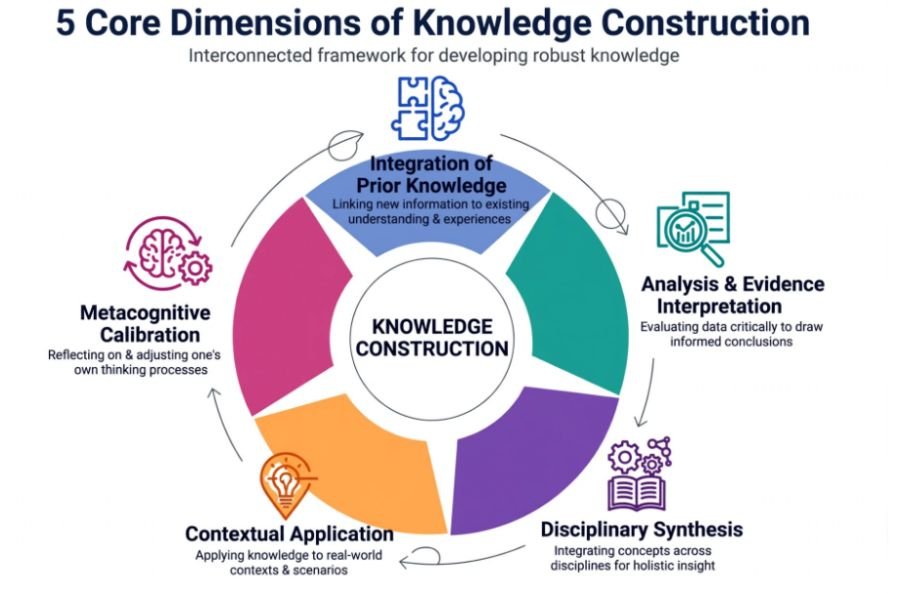
To evaluate real conceptual growth, an analytic rubric must measure five distinct cognitive dimensions.
Integration of Prior Knowledge vs. Recycled Facts
Surface-level submissions treat new course concepts as isolated silos. In contrast, deeper work intentionally connects fresh data to previously mastered frameworks. When instructors actively teach students construction of knowledge, learners explicitly connect prior experiences or foundational lessons to current inquiries, reshaping their earlier viewpoints.
Developing these skills becomes more effective when educators receive instructional coaching to build knowledge construction, helping them design learning experiences that encourage students to connect prior knowledge, critically evaluate evidence, and develop deeper understanding.
Analysis and Deconstructive Evidence Interpretation
Reliable rubrics measure how thoroughly a student interrogates their sources. Weak work accepts reference material uncritically, treating all sources as equal. Advanced work deconstructs underlying biases, unstated assumptions, and systemic limitations within source texts.
Disciplinary Synthesis and Conceptual Cross-Mapping
Synthesis involves helping students recognize and interpret connections between different ideas and representations. Rather than examining concepts in isolation, students develop a deeper understanding by identifying relationships across multiple graphical representations and using those connections to build a coherent analytical framework.
Contextual Application and Real-World Transfer
Understanding remains theoretical until it survives contact with new conditions. The Stanford Center for Assessment, Learning, and Equity (SCALE) champions performance assessments that evaluate how well students apply acquired concepts to authentic, unstructured scenarios without step-by-step guidance.
Dynamic Metacognitive Calibration
True knowledge construction produces cognitive shifts. Proficient students identify where their initial hypotheses failed, isolate the cognitive biases that distorted their early analysis, and adjust their reasoning through personalized problem-based learning.
Field-Tested Analytic Rubric for Knowledge Construction
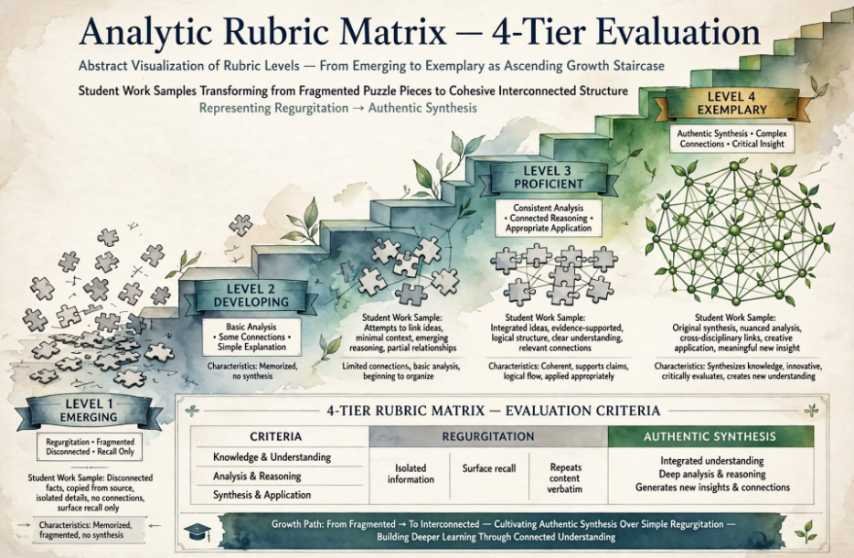
This four-tier matrix evaluates cognitive behaviors across these five core dimensions:
| Evaluation Criteria | Emerging (1) | Developing (2) | Proficient (3) | Exemplary (4) |
| Integration of Prior Knowledge | Restates new facts in isolation; makes no attempt to connect concepts. | Mentions prior ideas or experiences, but leaves connections superficial. | Seamlessly links new information to existing frameworks to expand understanding. | Synthesizes prior knowledge to reconstruct paradigms or reconcile conflicting views. |
| Analysis & Evidence Interpretation | Accepts claims uncritically; lacks external evidence or relies on a single source. | Identifies diverse sources, but treats them equally without analyzing bias or credibility. | Critically evaluates evidence from multiple sources to reveal patterns and underlying agendas. | Deconstructs complex, conflicting datasets to expose systemic nuances and hidden biases. |
| Synthesis & Conceptual Connection | Lists facts chronologically or at random; thoughts remain fragmented. | Summarizes takeaways clearly, but treats modules as strictly isolated silos. | Synthesizes disparate concepts to articulate unified relationships and frameworks. | Creates an innovative model bridging disparate disciplines to solve core dilemmas. |
| Application & Transfer | Struggles to apply concepts beyond the specific examples taught in class. | Applies ideas correctly to structured scenarios using guided prompts. | Independently transfers concepts to novel, unstructured real-world contexts. | Adapts models to address ambiguous conditions and design novel solutions. |
| Reflective Metacognition | Shows minimal awareness of learning processes or conceptual gaps. | Acknowledges changed perspectives, but cannot pinpoint the drivers of the shift. | Articulates how thinking evolved and outlines concrete cognitive next steps. | Evaluates cognitive trajectories, identifying personal blind spots and epistemological limits. |
Institutions using the Association of American Colleges and Universities (AAC&U VALUE Rubrics) rely on similar progressive developmental tiers to assess critical inquiry across undergraduate curricula.
Designing Tasks That Force Authentic Synthesis
Even a robust rubric fails if the underlying assignment invites rote memorization. The design of the task determines whether students construct new insights or merely summarize existing texts.
The Cookie Test and Non-Binary Prompts
Before distributing an assignment brief, apply the Cookie Test: Could a student reproduce this deliverable by assembling fragments of online summaries? If the answer is yes, the prompt fails.
Assignments should center on essential, non-binary questions. Instead of asking students to describe an economic policy, instruct them to evaluate how that policy produces unintended consequences in a specific regional labor market. Rooting inquiries in real-world tensions forces students to climb the higher cognitive tiers outlined in Vanderbilt Center for Teaching’s Bloom’s Taxonomy Framework.
Mandatory Cognitive Defense Protocols
To ensure submissions reflect original processing rather than polished compilations, require an accompanying Cognitive Defense Protocol. This section obligates students to justify their methodology:
- The Discarded Hypothesis: Identify one perspective considered during research and explain the exact data point that forced its elimination.
- Schema Reconstruction: Detail one specific assumption held before the project that was disproven by the findings.
- Boundary Conditions: Define the exact real-world scenario where the student’s proposed framework or solution would fail.
Adding this self-auditing component makes it impossible for students to score in the upper tiers through passive compilation.
Frequently Asked Questions
1. What separates knowledge construction from knowledge reproduction?
Reproduction repeats stored facts without modification, while construction synthesizes, tests, and transforms information into new personal frameworks.
2. Can quantitative problem sets use a knowledge construction rubric?
Yes, by evaluating how students interpret anomalies, defend formula choices, and transfer mathematical models to unstructured, novel data.
3. How do I prevent students from writing superficial metacognitive reflections?
Require students to cite explicit examples of their own initial errors and explain the exact logic that resolved them.
4. What is the fastest indicator of surface-level student work?
Submissions that organize facts sequentially as an uncritical list of source summaries without identifying tensions between those sources.
Stop Grading the Illusion of Understanding
Polished syntax and orderly references can easily mask a lack of genuine learning. If an assessment framework rewards passive compilation, students will naturally choose the path of least resistance.
Using dedicated rubrics for evaluating student construction of knowledge in student work challenges both the educator and the student. It shifts the classroom objective from assembling safe, sanitized summaries to generating hard-won intellectual breakthroughs. Implement this rubric on your next major project cycle to make critical thinking visible, measurable, and non-negotiable.