
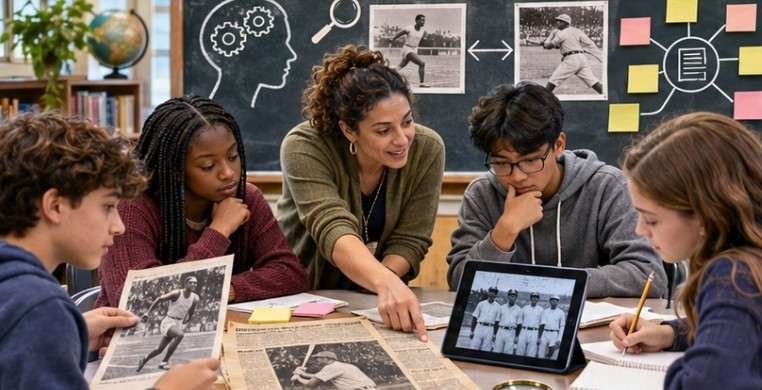
Sports History Critical Thinking Middle School for Teaching Students to Question the Past
Jackie Robinson’s first Major League Baseball game in 1947 was more than a sporting milestone. It challenged racial segregation and raised questions about equality, opportunity, and the influence of professional athletics on American society.
That connection makes sports history critical thinking middle school lessons particularly valuable. Instead of memorizing championship dates and famous athletes, students investigate why events happened, whose perspectives shaped the historical record, and how sports reflected broader social changes.
For educators, athletic history offers an engaging way to develop evidence-based reasoning, historical literacy, and analytical writing skills.
Historical Sports Events That Encourage Deeper Thinking
Selecting the right historical event can turn an ordinary social studies lesson into an investigation of American society.
Jackie Robinson and the Struggle for Civil Rights
Jackie Robinson’s Major League debut on April 15, 1947, challenged a longstanding racial barrier in professional baseball.
The Smithsonian’s National Museum of African American History and Culture documents how Robinson’s participation represented a wider struggle for racial equality.
Students can investigate newspaper coverage, photographs, and reactions from athletes and spectators.
Useful questions include:
- Why had professional baseball excluded Black players?
- How did different newspapers portray Robinson?
- Did integration in baseball immediately produce equality elsewhere?
This investigation connects athletic achievement with institutional discrimination and historical change.
Jesse Owens and Political Propaganda
At the 1936 Berlin Olympics, Jesse Owens won four gold medals while Nazi Germany attempted to promote its ideology of racial superiority.
His success created a powerful contradiction between athletic performance and racist political claims.
The Retro Report Jesse Owens history lesson provides educational material examining athletics, political messaging, and racial attitudes.
Retro Report+1
Ask students to compare international praise for Owens with the discrimination Black Americans continued experiencing at home.
This develops an understanding of historical contradictions and discourages oversimplified narratives.
Jim Thorpe and Fairness in Athletics
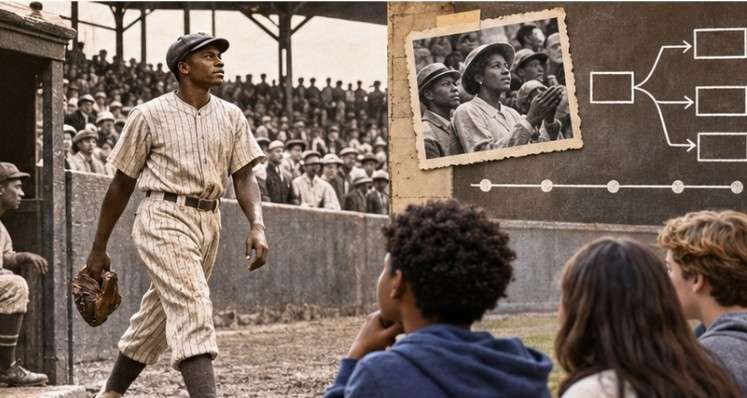
Jim Thorpe, a Native American athlete, won the pentathlon and decathlon at the 1912 Olympics.
His titles were subsequently withdrawn because of amateur eligibility rules. In 2022, the International Olympic Committee recognized Thorpe as the sole gold medalist in both events.
Olympics
Students can investigate whether historical athletic regulations were consistently fair and how institutions reconsider past decisions.
The discussion also provides opportunities to examine Indigenous representation and the historical treatment of Native American athletes.
The Miracle on Ice and Cold War Identity
The American hockey team’s 4–3 victory against the Soviet Union at the 1980 Winter Olympics became an enduring symbol of national pride.
Students should investigate why this particular sporting result carried meaning beyond the scoreboard.
Comparing American and Soviet interpretations can reveal how international competition becomes connected to nationalism, political rivalry, and public identity.
Teaching Students to Evaluate Historical Evidence
An effective sports history lesson requires students to work with original evidence rather than rely exclusively on contemporary summaries.
The National Archives document analysis worksheets provide structured approaches for studying photographs, documents, posters, and audiovisual records.
The National Archives recommends examining a source’s features, interpreting its meaning, and determining how it can support historical arguments.
National Archives
Compare Primary and Secondary Sources
Primary sources include historical newspapers, original photographs, contemporary letters, and recorded interviews.
Secondary sources include modern documentaries, textbooks, and historical interpretations.
For example, students investigating basketball’s development could compare James Naismith’s original 13 rules with modern basketball regulations.
They could then explain which changes affected competition, safety, or the pace of play.
Recognize Media Bias
Sports journalism provides particularly useful material for examining selective language.
Ask students to compare two historical reports about the same sporting event.
They should identify differences in headlines, descriptive vocabulary, quoted individuals, and omitted information.
A productive question is: Does the article explain what happened, or attempt to influence how readers should feel?
This exercise connects historical literacy with modern media evaluation.
A Five-Step Sports History Inquiry Activity
Teachers can introduce sports history critical thinking middle school activities through a structured classroom investigation.
The following exercise works particularly well for grades six through eight.
Step 1: Introduce a Debatable Question
Choose a historical problem that requires interpretation.
For example: Did Jackie Robinson change American society, or did changing social attitudes make his success possible?
Students should recognize that complex events rarely have a single explanation.
Step 2: Provide Contrasting Evidence
Distribute three accessible sources, such as a historical photograph, newspaper report, and modern historical analysis.
Explain the historical context and any unfamiliar vocabulary before students begin.
Step 3: Investigate Source Reliability
Students examine each source using four questions:
- Who created this material?
- When and why was it produced?
- What perspective does it represent?
- What additional evidence could challenge its claims?
Encourage students to distinguish unsupported assumptions from reasonable historical interpretations.
Step 4: Construct an Evidence-Based Argument
Students write a short paragraph stating their interpretation and supporting it with two pieces of evidence.
Require them to explain how each example supports their position rather than merely listing facts.
Step 5: Reconsider the Original Argument
After hearing alternative interpretations, students revise their conclusions.
This final step demonstrates that changing an opinion in response to stronger evidence is a sign of thoughtful reasoning.
Classroom Projects That Make Historical Thinking Visible
Historical investigation becomes more meaningful when students communicate their findings through creative assignments.
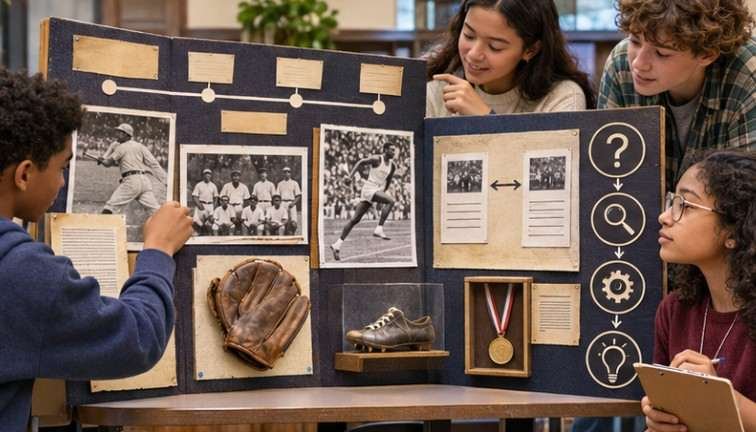
Historical Sports Museum
Student groups design small exhibitions featuring photographs, timelines, artifacts, and explanatory captions.
Each exhibition should answer a central question about historical significance.
Sports Journalism Investigation
Students examine historical headlines and then write their own balanced reports using verified evidence.
The ReadWriteThink baseball critical thinking lesson offers a grades 6–8 activity focused on researching baseball and developing thoughtful questions.
Read Write Think
Teachers can extend the approach by asking students to explain the reasoning behind their questions.
Athlete Perspective Debate
Assign students different historical viewpoints, such as athletes, journalists, administrators, and spectators.
Require each position to draw on documented evidence rather than imagined personal beliefs.
Offering a choice of projects can also support student ownership of learning, particularly when students select questions connected to their interests.
How Teachers Can Measure Critical Thinking Progress

A sports history assignment should assess reasoning, not simply factual recall.
A practical four-part evaluation checklist examines whether students can:
- Identify accurate historical evidence.
- Recognize different perspectives and possible bias.
- Explain relationships between sporting events and social conditions.
- Develop conclusions supported by relevant examples.
Teachers can score each category from one to four, producing a maximum of 16 points.
Use the results to identify specific areas requiring additional instruction.
Importantly, students unfamiliar with particular sports may need basic rules or historical background before attempting deeper analysis.
Athletic knowledge should never become a substitute for evaluating historical reasoning.
Frequently Asked Questions
1. How does sports history improve critical thinking in middle school?
Sports history encourages students to analyze evidence, compare perspectives, recognize bias, and explain historical causes and consequences instead of memorizing isolated facts.
2. Which sports history topics work best for middle school students?
Jackie Robinson, Jesse Owens, Jim Thorpe, women’s athletic opportunities, and the 1980 Olympic hockey tournament offer engaging connections to civil rights, politics, and social change.
3. Can sports history be integrated into English language arts?
Yes. Students can evaluate historical journalism, compare biographies, write evidence-based arguments, and analyze persuasive language while developing reading and writing skills.
4. How should teachers assess sports history critical thinking middle school projects?
Use rubrics measuring source evaluation, historical accuracy, interpretation, and argument quality. Reward clear reasoning and supporting evidence rather than the number of facts memorized.
The Real Lesson Behind the Scoreboard
The most meaningful sports history lessons begin with a familiar achievement and uncover the complicated circumstances surrounding it.
I believe students gain more from investigating why Jackie Robinson’s debut mattered than from simply remembering the year it happened. Historical understanding develops when learners question established narratives, examine conflicting evidence, and acknowledge perspectives that traditional accounts sometimes overlook.
Teachers do not need elaborate projects to encourage this thinking. A photograph, two contrasting newspaper reports, and one thoughtful question can create a valuable learning experience.
The goal is not to produce students who know every sports statistic. It is to develop young people who know how to question evidence, defend conclusions, and recognize history’s continuing influence.