
Why Planning Saves More Than Money
In commercial development, corporate construction, and high-end residential remodeling, the preliminary phase of a project is frequently treated as a bureaucratic hurdle. Eager to see physical progress, stakeholders often push to break ground, accelerate demolition, or pour concrete as quickly as possible. The underlying assumption is that speed equates to efficiency and that financial budgets are the only metric vulnerable to poor oversight.
However, rushing directly into execution reveals a fundamental misunderstanding of structural engineering and logistical design. While a rushed project might occasionally hit its initial financial target, it almost always defaults on non-monetary metrics that are far more difficult to recover: operational timeline integrity, material performance, team safety, and long-term asset value.
Meticulous upfront planning is not merely an exercise in accounting; it is a critical defensive framework. By stabilizing variables before physical work begins, project planners protect organizations from structural vulnerabilities, team fatigue, and catastrophic project down-cycles.
1. Preserving Critical Paths and Operational Timelines

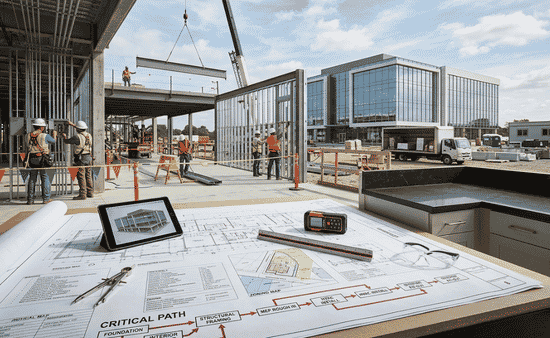
In large-scale buildouts, time is an unyielding, non-renewable resource. Every modern construction schedule relies on a “critical path”—a sequential chain of dependent tasks that directly dictates the project’s ultimate completion date. If a single foundational task along this path experiences a delay, it triggers a domino effect across every subsequent trade, resulting in idle crews, scheduling conflicts, and compound operational delays.
Amateur project execution routinely compromises this critical path by failing to account for physical lead times and structural dependencies. For example, installing heavy commercial equipment before reinforcing the subfloor structural framing forces a complete halt to the operation. Comprehensive planning systematically charts these geometric and mechanical interactions well in advance.
By mapping out exact lead times for specialized materials, securing zoning variances ahead of time, and establishing clear logistical handoffs between trade specialists, planners ensure the structural sequence remains entirely uninterrupted. The primary dividend here is not just cash saved on labor overhead; it is the absolute preservation of the delivery date.
2. Ensuring Material Performance and Interstitial Fit
Every building material carries unique physical profiles, thermal expansion coefficients, and installation tolerances. When a project moves forward without exhaustive schematic design, trades are forced to make ad-hoc adjustments in the field to reconcile incompatible components. These impromptu modifications frequently alter the engineering integrity of the building envelope, leading to premature material failure.
Consider the precision required in complex interior environments like commercial kitchens or high-end laboratory spaces. If the structural framing or plumbing layouts deviate by even a fraction of an inch from the architectural blueprint, primary surface installations will fail to fit properly.
This attention to detail is what transforms a blueprint to reality, ensuring that every structural, mechanical, and design element aligns precisely with the original vision while maintaining functionality, safety, and long-term performance.
In residential and commercial kitchen design, for instance, attempting to install premium quartz countertops in Salt Lake City onto cabinets that have not been perfectly leveled creates uneven weight distribution and structural stress points.
Because engineered quartz is a highly dense, non-porous material designed for exceptional structural longevity, it demands a perfectly flat, unyielding foundation to prevent structural flexing or joint separation over time. Meticulous spatial planning ensures that sub-surfaces, cabinetry, and heavy slab materials interface flawlessly without requiring destructive field retrofits.
3. Minimizing Human Fatigue and On-Site Safety Hazards

The physical hazards of a chaotic construction zone are directly proportional to the quality of its logistical planning. When a project falls behind schedule due to poor coordination, management teams almost always attempt to compress the timeline by demanding mandatory overtime or stacking multiple trades into the same physical space simultaneously—a phenomenon known as trade crowding.
Trade crowding introduces severe friction to the job site. Having electrical technicians, drywall contractors, and mechanical pipefitters working on top of one another drastically increases ambient noise levels, limits spatial maneuvering clearance, and obscures visible safety markings.
These challenges highlight why top property developers place such a strong emphasis on detailed planning, phased scheduling, and effective coordination among trades to maintain safety, productivity, and project quality throughout the construction process.
Furthermore, continuous physical exhaustion compromises a worker’s spatial awareness and reaction times, spiking the statistical probability of structural accidents, tool drops, and heavy machinery collisions.
Thorough planning eliminates this human friction by creating realistic, staggered shift schedules and establishing dedicated spatial zones for material storage, fabrication, and assembly. Protecting the physical well-being of the workforce ensures the site remains secure, orderly, and fully compliant with occupational safety regulations.
4. Protecting Institutional Reputation and Brand Equity
For corporate entities, real estate developers, and institutional builders, a construction project is never an isolated mechanical event; it is a direct reflection of corporate capability and brand integrity. When a major build out suffers from public delays, visible structural errors, or post-occupancy performance failures, the damage to the organization’s reputation can be permanent.
An unbending commitment to the planning phase communicates absolute operational maturity to investors, local municipalities, and future occupants. It ensures that every structural detail—from thermodynamic insulation values to advanced drainage networks—is fully vetted against rigorous engineering standards rather than left to guesswork.
This institutional discipline builds deep trust across the local market, making it significantly easier to secure prime capital, negotiate municipal permits, and attract elite trade partners for subsequent operations.
Conclusion
The true value of comprehensive project planning can never be fully captured on a simple balance sheet. It is a calculated triumph of spatial discipline and mechanical foresight achieved by replacing chaotic, reactive field decisions with stabilized operational paths, precise material integration, orderly safety protocols, and unyielding brand standards.
By elevating the planning phase to a non-negotiable core discipline, organizations successfully insulate their investments from the volatile realities of physical construction. Ensuring that every structural interaction is accounted for long before a single tool is lifted transforms a complex construction liability into a smooth, predictable, and incredibly resilient journey toward absolute operational excellence, asset longevity, and uncompromised human protection.